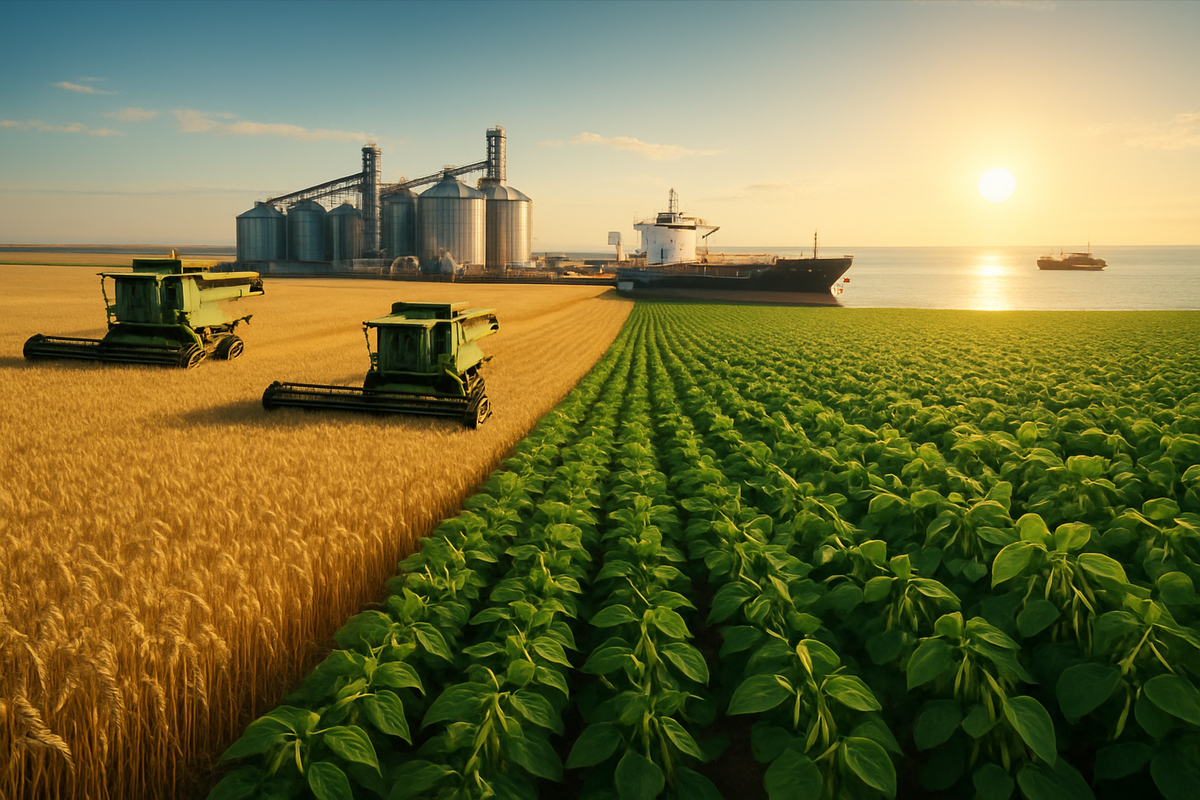
As of late December 2025, the global agricultural landscape is being fundamentally redrawn by a "South American Divergence" that has defied previous market expectations. While much of the Northern Hemisphere has grappled with erratic weather and geopolitical trade friction, South America has emerged as the world’s undisputed breadbasket for the 2025/26 cycle. Argentina has stunned analysts by securing a record-breaking wheat harvest of 24 million tons, while Brazil is on track to deliver a staggering 175 million metric tons of soybeans, cementing its status as the dominant force in global oilseed production.
This massive influx of supply from the Southern Hemisphere is creating a ripple effect across global commodity exchanges. As the year draws to a close, the sheer volume of these crops—combined with a strategic pivot by Chinese buyers—is putting intense downward pressure on prices at the Chicago Board of Trade (CBOT). For global agribusiness giants and equipment manufacturers, this divergence represents both a logistical challenge and a massive strategic opportunity, as the center of gravity for global food security shifts decisively toward the South Atlantic.
The Perfect Storm: Record Yields and Strategic Shifts
The road to these record-breaking figures began in early 2025 with a shift in the ENSO (El Niño-Southern Oscillation) cycle that proved remarkably beneficial for the Argentine Pampas. After years of struggling with drought, Argentina’s wheat-growing regions received "exceptionally favorable" winter and spring rains, replenishing soil moisture to levels not seen in a decade. This allowed farmers to expand planted areas to nearly 6.9 million hectares. Despite a late-season frost scare in November, the high ambient humidity served as a thermal buffer, preserving a yield that local exchanges now estimate could eventually climb as high as 27 million tons, far exceeding the official 24-million-ton baseline.
In Brazil, the story is one of resilience against climate volatility. The 2025/26 soybean season was initially threatened by a peak in the La Niña pattern, which caused significant planting delays in southern states like Rio Grande do Sul. However, the central-west "soy belt," led by Mato Grosso, experienced well-above-average precipitation that more than compensated for southern dryness. Brazilian producers, betting on the continued weakness of the Real and insatiable demand from Asia, expanded their acreage by another million hectares. This expansion, coupled with high-tech seed adoption, has brought the 175-million-metric-ton projection within reach, a figure that would have seemed impossible just five years ago.
The primary catalyst for this production boom remains the insatiable appetite of China. By December 2025, Chinese soybean imports for the calendar year are on track to exceed 110 million tons. Crucially, state-run buyers like COFCO have aggressively favored South American origins over North American supply. In November 2025 alone, Argentine soybean arrivals in China surged by over 600% year-over-year. While a fragile "trade truce" exists between Washington and Beijing, a lingering 13% tariff on U.S. agricultural goods has kept the bulk of Chinese demand centered on the competitive pricing offered by the record-breaking South American harvests.
Winners and Losers in the Agribusiness Sector
The divergence in South American production has created a clear divide among the "ABCD" group of global grain traders. Bunge Global SA (NYSE: BG) has emerged as a primary beneficiary of this trend. With a deep physical footprint in South America and the successful integration of its Viterra merger, Bunge has been perfectly positioned to handle the record wheat volumes flowing out of Rosario and the soybean surge from Brazil’s interior. The company’s ability to leverage local processing margins has allowed it to outperform peers who are more reliant on North American export infrastructure.
In contrast, Archer-Daniels-Midland (NYSE: ADM) has faced a more difficult 2025. The company reported its weakest profits in five years this quarter, largely due to the "trade upheaval" that saw Chinese buyers bypass U.S. silos in favor of South American ports. While ADM remains a global powerhouse, the compression of North American export margins and the high cost of maintaining idle capacity in the U.S. Midwest have weighed heavily on its shares.
The impact also extends to the heavy machinery sector. Deere & Company (NYSE: DE) has navigated a cautious 2025, facing nearly $600 million in tariff-related costs and a slowdown in U.S. equipment sales as North American farmers tighten their belts. However, the record harvests in the South are creating a "replacement cycle" opportunity. As Brazilian and Argentine farmers see record throughput, the demand for high-capacity harvesters and precision agriculture technology is expected to spike in early 2026. Meanwhile, Corteva (NYSE: CTVA) has remained resilient, as its focus on biologicals and high-yield seed technology has become essential for South American farmers looking to maximize output in the face of fluctuating commodity prices.
A New Global Trade Map
The 2025 South American harvest is more than just a seasonal fluke; it represents a structural shift in global trade. For decades, the U.S. was the "swing producer" that the world relied on to fill supply gaps. Today, that role has shifted. The ability of Brazil and Argentina to produce record crops even during volatile weather cycles suggests that South American infrastructure—long considered a bottleneck—is finally catching up to its biological potential. This has significant implications for global food security, as the world becomes increasingly dependent on a single geographic corridor for its protein and carbohydrate needs.
Furthermore, China’s strategy of "diversified dependence" is now fully visible. By funding infrastructure projects in Brazil and signing long-term procurement deals in Argentina, Beijing has effectively insulated itself from North American trade policy. This creates a challenging environment for U.S. policymakers, who find their traditional "food power" diluted by the sheer scale of South American production. The historical precedent of the 1980s grain embargoes comes to mind, but with a modern twist: this time, the alternatives to U.S. supply are not just available; they are superior in both volume and price.
The regulatory environment is also shifting. With the European Union’s Deforestation Regulation (EUDR) coming into full effect, South American producers have had to pivot their logistics to ensure that these record crops are compliant for global markets. This has led to a bifurcated market where "certified sustainable" soy and wheat command a premium, further benefiting large, sophisticated players like Bunge and Corteva who have the technology to track supply chains from farm to port.
The Road Ahead: 2026 and Beyond
Looking toward the first half of 2026, the primary challenge for the market will be logistics. Moving 175 million tons of soybeans out of the Brazilian interior and 24 million tons of wheat from the Argentine heartland will test the limits of the Paranaguá and Rosario port complexes. Any labor strikes or infrastructure failures during the peak shipping season in February and March could cause sudden, violent spikes in localized basis prices, even as global futures remain depressed.
Investors should also watch for a potential "acreage war" in the next planting cycle. With wheat and soybean prices at multi-year lows due to the current glut, farmers in the U.S. and South America may be forced to make difficult decisions about crop rotation. If South American producers continue to expand acreage despite low prices—driven by currency advantages—it could lead to a prolonged period of "lower for longer" agricultural commodities, challenging the profitability of the entire value chain.
Navigating the Bumper Crop Reality
The 2025 South American agricultural divergence marks a turning point in the global economy. Argentina’s 24-million-ton wheat miracle and Brazil’s 175-million-ton soybean behemoth have proven that the Southern Hemisphere is no longer just a secondary supplier; it is the market’s primary engine. For the global public, this means a period of relative food price stability, but for the companies that move, process, and support these crops, the landscape has never been more competitive.
Moving forward, the market will be defined by logistical efficiency and geopolitical alignment. Investors should keep a close eye on South American port capacity and Chinese import quotas in the coming months. While the current glut is a boon for consumers, the long-term health of the agribusiness sector will depend on whether demand can rise to meet this new, massive baseline of South American production.
This content is intended for informational purposes only and is not financial advice.