As the final bells of the 2025 trading year echo through the canyons of Wall Street, the technology sector is delivering a masterclass in resilience. The Nasdaq Composite (NASDAQ: IXIC) closed the shortened Christmas Eve session at 23,561.84, capping a remarkable December rally that has seen the index reclaim key psychological levels and set its sights on uncharted territory. This "Santa Claus rally" is not merely a seasonal phenomenon but the culmination of a year defined by the transition from artificial intelligence speculation to concrete industrialization.
The immediate implications of this surge are profound for both institutional portfolios and retail investors. With the S&P 500 (NYSEARCA:SPY) also hitting record highs of 6,909.79 this week, the broader market is riding a wave of optimism fueled by a cooling inflationary environment and a Federal Reserve that appears committed to a "soft landing" glide path. For the tech-heavy Nasdaq, the current momentum suggests that the "AI 2.0" era is officially underway, providing a robust floor for valuations even as the market enters a typically volatile election-cycle hangover period in the coming year.
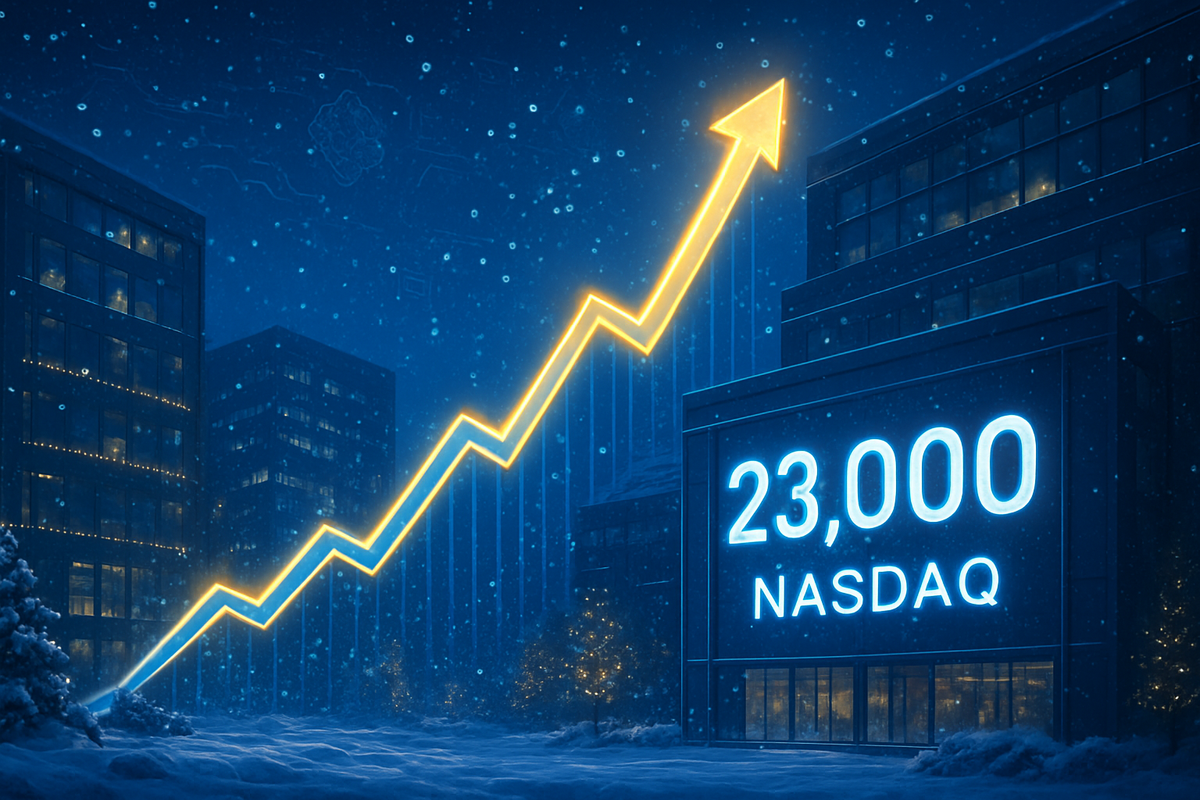
The Path to 23,000: A December to Remember
The road to this year-end milestone was far from a straight line. The technology sector entered the fourth quarter of 2025 under a cloud of "AI fatigue," as investors questioned the massive capital expenditures of the "Magnificent Seven" and sought evidence of tangible returns. This skepticism triggered a sharp 10% correction between October and early December, which saw the Nasdaq dip briefly below its 200-day moving average. However, the narrative shifted dramatically in mid-December, following a series of blowout earnings reports from the semiconductor industry and a pivotal policy shift from the central bank.
The turning point arrived on December 10, 2025, when the Federal Open Market Committee (FOMC) announced a 25-basis-point interest rate cut, bringing the benchmark rate to a range of 3.50%–3.75%. This was the sixth cut in a cycle that began in late 2024, signaling to markets that the Fed was satisfied with the trajectory of core inflation. The liquidity injection acted as high-octane fuel for growth stocks, particularly those in the high-performance computing and software-as-a-service (SaaS) sectors. By December 19, the Nasdaq had reclaimed the 23,000 mark, breaking through a resistance level that had held firm for nearly three months.
Key stakeholders, including institutional asset managers and Silicon Valley venture capitalists, have pointed to the "Silicon Renaissance" as the driving force behind this recovery. Unlike the hype-driven rallies of 2023 and 2024, the late 2025 surge has been characterized by "Agentic AI"—autonomous systems capable of executing complex business workflows without human intervention. This technological leap has moved AI from a "chat" interface to a core productivity engine, prompting a massive reallocation of capital into the infrastructure players that make these systems possible.
Initial market reactions to the December surge have been overwhelmingly positive, with the CBOE Volatility Index (VIX) retreating to 14, a level indicative of high investor confidence. While some analysts cautioned that the 4.3% GDP growth reported in late December might eventually force the Fed to pause its easing cycle, the prevailing sentiment on the floor of the New York Stock Exchange this Christmas Eve is one of relief and exuberance. The "AI 2.0" breakthrough has effectively silenced the bears who predicted a 2000-style tech bubble burst, at least for the time being.
Winners and Losers in the AI 2.0 Breakthrough
The undisputed king of the 2025 rally remains Nvidia (NASDAQ: NVDA), which achieved a historic $5 trillion market capitalization this quarter. Nvidia’s Blackwell architecture has become the gold standard for the global data center build-out, with demand continuing to outstrip supply even as we head into 2026. On December 23 alone, the stock rose another 3%, acting as the primary engine for the Nasdaq’s upward move. Investors who bet on the "infrastructure plumbers" of the AI world have seen outsized returns, with Nvidia’s dominance appearing increasingly unassailable in the short term.
Other major winners include the semiconductor networking and memory specialists. Marvell Technology (NASDAQ: MRVL) and Micron Technology (NASDAQ: MU) have both outperformed the broader index this month, gaining 3.4% and 2.8% respectively in the lead-up to the holiday. Micron, in particular, has benefited from the insatiable demand for high-bandwidth memory (HBM) chips, which are essential for the next generation of AI servers. Broadcom (NASDAQ: AVGO) has also seen a significant lift, as its custom ASIC (Application-Specific Integrated Circuit) business continues to win massive contracts from hyperscalers like Alphabet (NASDAQ: GOOGL) and Meta Platforms (NASDAQ: META).
On the software side, Palantir Technologies (NASDAQ: PLTR) has emerged as a standout winner, with its stock price soaring approximately 158% year-to-date. Palantir’s ability to integrate "Agentic AI" into industrial and government workflows has made it a darling of the 2025 rally. Similarly, Western Digital (NASDAQ: WDC) has seen a staggering 275% gain through late December, as the "hard side" of the AI trade—specifically data storage and enterprise SSDs—became a critical bottleneck that the company was uniquely positioned to solve.
However, the rally has not been a rising tide for all boats. Legacy hardware companies that failed to pivot quickly to AI-native architectures have struggled to keep pace, with some trading flat or even down for the year. Additionally, consumer-facing tech companies reliant on discretionary spending have faced headwinds from the "higher-for-longer" retail interest rates that preceded the Fed’s recent cuts. While Apple (NASDAQ: AAPL) and Microsoft (NASDAQ: MSFT) remain pillars of the index, their growth rates have been eclipsed by the more nimble, specialized AI infrastructure firms, leading to a slight reweighting of investor priorities within the tech sector.
The Significance of the Silicon Renaissance
The 2025 year-end rally is more than just a series of green candles on a chart; it represents a fundamental shift in the global economic landscape. We are witnessing the "Industrialization of Intelligence," where AI is no longer a peripheral tool but the central nervous system of the modern corporation. This shift is evidenced by the staggering capital expenditure commitments from Big Tech; Microsoft, Alphabet, Amazon (NASDAQ: AMZN), and Meta have collectively funneled over $400 billion into AI-related CapEx in 2025 alone. This level of investment is historically unprecedented, surpassing the relative spending seen during the build-out of the internet in the late 1990s.
The ripple effects of this rally are being felt far beyond Silicon Valley. Competitors in the automotive, healthcare, and financial services sectors are being forced to accelerate their own AI adoption strategies to remain relevant. This has created a secondary wave of demand for tech services, benefiting consulting firms and cloud providers alike. Furthermore, the regulatory environment is beginning to catch up, with 2025 seeing the first major "AI Safety and Sovereignty" frameworks being implemented in the U.S. and EU. Rather than stifling growth, these regulations have provided a degree of legal certainty that has encouraged institutional "big money" to enter the space.
Comparisons to the dot-com era are inevitable, but many analysts argue that the 2025 rally is built on a much firmer foundation. Unlike the profitless companies of 1999, the leaders of the current rally—Nvidia, Alphabet, and Meta—are generating record-breaking free cash flow and maintaining robust margins. The historical precedent here is perhaps closer to the electrification of the 1920s or the deployment of the interstate highway system in the 1950s—a massive infrastructure build-out that will serve as the platform for decades of future economic activity.
However, the rally also highlights a growing divide between the "AI haves" and "AI have-nots." This divergence is likely to trigger a wave of consolidation in 2026, as larger players use their inflated stock currency to acquire smaller firms with specialized AI intellectual property. For policymakers, the challenge will be balancing the need for innovation with the risks of monopolistic control over the foundational models that are increasingly running the global economy.
Looking Ahead to 2026: Milestones and Minefields
As we look toward the first quarter of 2026, the primary question for investors is whether the Nasdaq can maintain this velocity and pierce the 25,000 mark. In the short term, the market will be hyper-focused on the January 2026 FOMC meeting. While the December cut was a gift to the bulls, the robust 4.3% GDP growth suggests that the Fed may need to tap the brakes to prevent the economy from overheating. Any signal of a "hawkish pause" could lead to a healthy consolidation period in late January or February.
Strategically, the next phase of the rally will likely shift from hardware to the "application layer." While 2025 was the year of the chip and the data center, 2026 is expected to be the year where enterprises begin to show significant ROI from their AI investments. Companies that can demonstrate how Agentic AI is reducing costs or creating new revenue streams will be the next leaders of the index. This will require a strategic pivot for many software firms, moving away from per-seat licensing models toward value-based or consumption-based pricing.
Potential challenges remain on the horizon, including geopolitical tensions and the ongoing "chip wars" which could disrupt supply chains for essential components. Furthermore, the "tariff man" shocks seen earlier in 2025 serve as a reminder that trade policy can shift rapidly, potentially impacting the global operations of the Nasdaq’s largest constituents. Investors should watch for the Q4 2025 earnings season, which begins in late January, as it will provide the first real data on how the holiday rally translated into corporate bottom lines.
Closing Thoughts on a Historic Year
The 2025 year-end rally has been a testament to the enduring power of technological innovation to drive market sentiment and economic growth. From the Nasdaq’s triumphant reclaim of the 23,000 level to Nvidia’s ascent to a $5 trillion valuation, the milestones reached this December will likely be remembered as the beginning of the "AI 2.0" era. The market is moving forward with a renewed sense of purpose, grounded in the reality of AI monetization rather than the ephemeral promises of the past.
For investors, the key takeaway is that the technology sector has matured. The volatility of the early 2020s has given way to a more disciplined, infrastructure-heavy growth model. While the "Santa Claus rally" provides a festive end to the year, the real work begins in 2026 as the industry seeks to prove that this massive build-out can deliver sustained productivity gains across the entire economy.
Moving forward, the market will be watching for signs of AI integration in traditional sectors and the potential for a broader participation in the rally beyond the mega-cap tech giants. As the 10-year Treasury yield hovers around 4.17%, the balance between growth and valuation will remain a delicate one. For now, however, the bulls are in control, and the technology sector is heading into the New Year with the wind at its back and a new set of record highs in its sights.
This content is intended for informational purposes only and is not financial advice.