For decades, business owners have tracked the same core numbers: revenue, margins, cash flow, and profit. These figures told the whole story of a company's health. But a quieter, less obvious metric has started creeping into boardroom conversations — one that used to belong entirely to marketing teams.
That metric is online visibility.
Search rankings, brand mentions, review scores, and digital footprint were once treated as soft, marketing-only concerns. Increasingly, they're being examined by CFOs, investors, and lenders as indicators of a company's real-world financial trajectory. A business that's easy to find, trusted online, and consistently visible in search results tends to acquire customers more efficiently, negotiate better terms with partners, and present a stronger case during funding or acquisition talks.
This shift raises a fair question: is online visibility actually a financial metric, or is this just marketing dressing itself up in finance language? The data — and the behavior of investors, lenders, and acquirers — suggests it's more than semantics. This article breaks down exactly how visibility connects to revenue, valuation, and long-term business resilience, and what that means for how you should be thinking about it.
What "Online Visibility" Actually Means in a Business Context
Online visibility is often reduced to "showing up on Google," but that's an incomplete definition. In a business context, visibility refers to how easily and how often a company can be discovered, verified, and trusted across the digital channels where its customers, partners, and investors are actually looking.
That includes search engine rankings, but it also extends to third-party mentions, review platform presence, directory listings, and the overall digital footprint a business leaves behind. A company can have a functional website and still be functionally invisible if none of these signals are working together.
For business owners weighing how to approach this without an in-house marketing team, working with a specialist who understands both the technical and commercial sides of search can make the difference between scattered effort and a measurable, business-aligned plan. Consultants such as Aidan Coleman SEO work specifically within this space, helping businesses translate visibility goals into strategies that connect back to actual growth, rather than vanity metrics.
Visibility vs. Brand Awareness — Why the Distinction Matters
Brand awareness and online visibility get used interchangeably, but they're not the same thing. Awareness is about perception — whether people recognize your name. Visibility is about discoverability — whether people can actually find you when they're ready to buy, invest, or partner.
A regional business might have strong brand awareness within its own network but almost no visibility to someone searching for its services online for the first time. That gap matters, because discoverability has a direct, trackable line to revenue in a way that general awareness often doesn't.
Why Finance Teams Are Starting to Pay Attention to Digital Presence
It's no longer unusual for financial leadership to review digital performance data alongside traditional financial statements. Part of this comes down to customer acquisition cost. Businesses with strong organic visibility tend to rely less on paid advertising over time, which directly reduces the cost of acquiring new customers and improves overall margin health.
Financial analysts have also started treating digital presence as one of many indicators of business durability. A company that consistently ranks for the terms its customers search for tends to have more predictable, lower-cost customer acquisition than one dependent entirely on paid channels that stop producing the moment spending stops.
The Rise of "Intangible Assets" on the Modern Balance Sheet
This connects to a broader shift in how business value is calculated. Traditional balance sheets were built around tangible assets — equipment, property, inventory. But research from intangible asset studies, including well-known analyses by Ocean Tomo, has shown that intangible assets now make up the large majority of enterprise value across S&P 500 companies, a dramatic reversal from several decades ago when tangible assets dominated.
Brand equity, intellectual property, customer relationships, and — increasingly — digital presence all fall under this intangible category. Online visibility doesn't sit on a balance sheet the way inventory does, but its effects on customer acquisition, brand trust, and market positioning contribute to the same kind of enterprise value that intangible asset accounting is designed to capture.
How Online Visibility Translates Into Revenue
Organic Discovery and the Customer Journey
When a potential customer searches for a solution and finds a business through organic, unpaid search results, that discovery carries more inherent trust than a paid ad in the same position. Organic visibility shortens the distance between a customer's need and a business's solution, particularly for considered purchases where research happens before contact.
This is especially true in B2B and professional services, where buyers frequently research a company thoroughly before ever reaching out. A business that's difficult to find or has thin digital credibility loses ground at exactly the moment a prospective customer is deciding who to trust.
The Compounding Effect of Search Visibility Over Time
Paid visibility behaves like a linear cost: spend money, get placement, spend more, get more placement. Stop spending, and the visibility disappears almost immediately. Organic visibility works differently. It behaves more like compound interest — each piece of quality content, each earned link, and each improvement in site authority adds to a foundation that keeps producing results long after the initial investment.
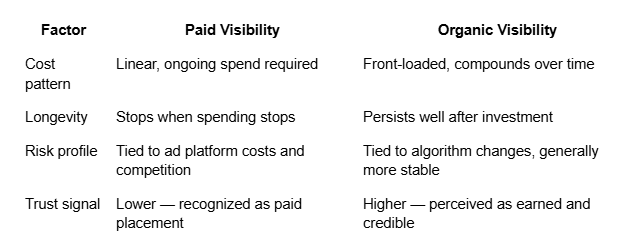
This compounding effect is precisely why financially minded business owners are starting to evaluate visibility the way they'd evaluate any other long-term investment, rather than as a recurring marketing expense.
Does Online Visibility Affect Business Valuation?
How Investors and Acquirers Evaluate Digital Presence in Due Diligence
Digital due diligence has become a standard part of many acquisition and investment processes. Buyers and investors routinely review a target company's search visibility, domain authority, review sentiment, and overall online reputation as part of assessing risk and growth potential.
A company with weak digital visibility relative to its competitors can raise questions during this process — not because visibility alone determines value, but because it signals something about customer acquisition efficiency, brand strength, and future growth capacity. Conversely, strong, consistent visibility across search and reputation channels can support a stronger negotiating position, since it demonstrates a lower-risk, more sustainable path to future revenue.
Lenders and Digital Trust Signals
Even outside formal M&A processes, digital trust signals can quietly influence how a business is perceived by lenders and partners. Review consistency, complaint patterns, and overall online reputation are increasingly used as soft risk indicators, particularly for small and mid-sized businesses that don't have decades of financial history to lean on.
This doesn't mean a bank is pulling up search rankings before approving a loan. But in a lending environment that increasingly incorporates alternative data, a business's digital footprint is one more data point that can either support or undermine confidence in its stability.
The Hidden Cost of Low Visibility (What It's Actually Costing Businesses)
Low visibility rarely shows up as a single line item on a financial statement, which is exactly why it's so easy to underestimate. Instead, it shows up as a pattern of inefficiencies: higher customer acquisition costs, weaker negotiating leverage, and slower growth relative to competitors who are easier to find.
Businesses in this position often don't realize how much revenue they're leaving on the table until they compare their performance against competitors with stronger digital presence in the same market.
Signs your business may have a visibility problem:
Reliant almost entirely on paid ads for new customer acquisition
Competitors consistently outrank you for your own core service terms
Low volume or inconsistent online reviews compared to competitors
Website traffic has plateaued despite steady offline growth
Little to no organic search presence for the services you actually offer
How to Start Measuring Online Visibility Like a Financial Metric
Key Visibility KPIs Worth Tracking
Treating visibility as a financial metric means tracking it with the same discipline applied to revenue or margin. A few of the most useful indicators include:
Organic traffic growth rate — the trend line matters more than any single month's number
Share of voice / share of search — how often your business appears relative to competitors for relevant terms
Branded vs. non-branded search volume — a growing ratio of non-branded searches often signals expanding market reach
Domain authority and referring domain trends — a proxy for overall digital credibility
Conversion rate from organic channels — connects visibility directly to revenue outcomes, not just traffic volume
Connecting Visibility Metrics to Revenue Reporting
The harder part isn't collecting these numbers — it's connecting them meaningfully to financial reporting. This usually requires some form of attribution modeling, whether a simple last-click approach or a more sophisticated multi-touch model that credits multiple stages of the customer journey.
For many small and mid-sized businesses, formalizing this connection is where things get complicated, particularly when it comes to reflecting marketing-driven growth accurately in financial statements and forecasts. This is often the point where it makes sense to loop in financial professionals who understand how to translate operational and marketing data into figures that hold up under scrutiny — whether for internal decision-making, lender conversations, or investor reporting. Experienced Business Accountants can help ensure that revenue attributed to digital growth is captured accurately and presented in a way that strengthens, rather than complicates, a business's overall financial picture.
Building Long-Term Visibility Without Overspending
Businesses that build visibility sustainably tend to avoid the volatility that comes with pure paid-advertising dependency. Instead, they compound trust and rankings over time through technical site health, consistent content, and credible authority signals earned rather than purchased.
This is where strategy quality matters more than budget size. The difference between a short-lived ranking spike and durable, revenue-relevant visibility usually comes down to whether the underlying approach is built for the long term or optimized for quick wins that fade once attention moves elsewhere.
Whatever approach a business takes, the underlying principle holds: visibility built to last behaves less like a marketing expense and more like a compounding business asset.
Online Visibility Is a Long-Term Asset, Not a Marketing Expense
The businesses that will benefit most from this shift are the ones that stop treating online visibility as a discretionary marketing line item and start treating it as a strategic asset worth measuring, reporting on, and investing in deliberately.
That doesn't mean every business needs to overhaul its financial reporting overnight. It does mean recognizing that visibility data belongs in the same conversation as revenue, margin, and growth planning — not siloed away in a marketing dashboard nobody outside that department ever sees.
As digital and financial performance continue to intertwine, the businesses that connect the two earliest will have a clearer, more accurate picture of where their real growth is coming from — and a stronger position when it comes time to raise capital, secure financing, or negotiate an exit.
Conclusion
Online visibility has quietly moved from a marketing afterthought to a genuine indicator of financial health, influencing everything from customer acquisition costs to how investors assess risk during due diligence. Businesses that track it with the same discipline applied to revenue and margins gain a clearer, earlier view of where sustainable growth is actually coming from. As intangible assets continue to make up a larger share of enterprise value, visibility deserves a seat in financial planning conversations, not just marketing meetings. The businesses that recognize this shift now will be better positioned to raise capital, negotiate financing, and demonstrate durable value when it matters most.
Frequently Asked Questions
Is online visibility really a financial metric, or is that just a marketing claim?
It's a legitimate financial consideration, though not in the traditional sense of appearing directly on a balance sheet. Online visibility functions similarly to other intangible assets — brand equity, intellectual property, customer relationships — that increasingly make up the majority of enterprise value for modern businesses. Its financial relevance comes from measurable effects on customer acquisition cost, revenue predictability, and valuation during investment or acquisition processes.
How do I measure the ROI of online visibility?
Start with core KPIs like organic traffic growth, share of search relative to competitors, and conversion rates from organic channels. From there, attribution modeling — even a simple version — can help connect those numbers to actual revenue, giving you a clearer picture of return relative to the effort invested.
Do small businesses need to worry about this as much as large companies?
Often more so. Small and mid-sized businesses typically rely more heavily on local and organic discovery and have less brand equity to fall back on if visibility drops. A large, established brand can survive a visibility dip on reputation alone; a smaller business usually can't.
How long does it take for visibility improvements to show financial results?
Most businesses start seeing meaningful movement within four to twelve months, depending on competition levels and starting position. Because organic visibility compounds rather than delivering instant results, patience and consistency matter more than short-term tactics.
Can poor online visibility actually hurt my business's valuation?
It can be a contributing factor, particularly during formal due diligence. Weak digital presence relative to competitors can raise questions about customer acquisition efficiency and long-term growth potential, both of which factor into how buyers and investors assess risk and value.