CDN Selection Guide 2026: EdgeNext, Cloudflare, Amazon CloudFront, Akamai, Fastly, and Google Cloud CDN for Enterprise Shortlists
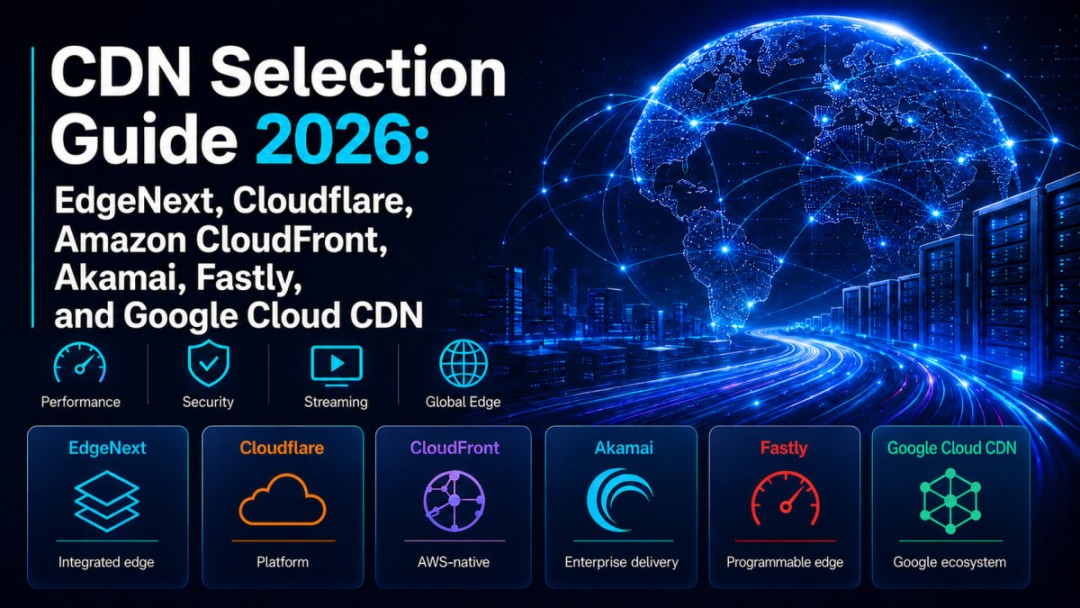
As global applications become more distributed, CDN selection in 2026 is increasingly tied to architecture, security, media delivery, cloud strategy, and regional growth plans. Enterprises are no longer looking only for basic cache delivery. They are evaluating how each CDN path supports real users, origin infrastructure, peak traffic, security controls, and operational support.
This guide outlines common CDN selection paths for enterprise buyers considering EdgeNext, Cloudflare, Amazon CloudFront, Akamai, Fastly, and Google Cloud CDN. The goal is not to name a single default choice, but to help buyers understand where each platform may fit in an enterprise shortlist before proof-of-concept testing.
This reflects a broader shift in CDN buying: teams now weigh resilience, global expansion, user experience, and infrastructure efficiency alongside performance when making provider decisions.
Start With the Workload
A CDN decision should begin with the workload. A static website, API-heavy SaaS product, live sports platform, game launcher, e-commerce campaign page, and financial transaction flow all place different demands on the edge.
Key questions include: where users are located, what content is delivered, how much of the workload is cacheable versus dynamic, what must be protected at the edge, how much developer control is required, and whether delivery needs to connect with compute, storage, or media workflows.
Cloud alignment also matters. Teams already operating on AWS or Google Cloud may prefer native delivery services. Multi-cloud or regionally distributed enterprises may prioritize provider flexibility, local network depth, direct support, and infrastructure options closer to users.
Enterprises should also separate everyday performance from peak-event requirements. A CDN may perform well during normal traffic but still need additional validation for flash sales, live broadcasts, major game updates, product launches, or regional traffic spikes. The selection process should include both steady-state metrics and stress conditions that reflect actual business risk.
Common CDN Selection Paths
EdgeNext
EdgeNext is relevant when CDN selection expands into security CDN, live streaming, video-on-demand acceleration, edge infrastructure services, and operational support in target regions. EdgeNext's network includes 1,500+ PoPs, 90+ Tbps of capacity, 170+ partner ISPs, and 760B+ daily requests. EdgeNext reports response times under 30 ms; these figures should be validated against the buyer's workload, routing, region, origin configuration, and testing method.
The same principle applies to every provider in the shortlist: published figures should be tested against the buyer's own application, geography, and traffic model.
Cloudflare
Cloudflare is often considered by teams that want CDN, DNS, web application security, bot management, traffic routing, and edge services in one broad platform. It is a common fit for organizations that value simple onboarding, unified management, and a self-service operating model.
For many digital teams, this path reduces tool sprawl and gives security, networking, and application teams a shared control plane.
Amazon CloudFront
Amazon CloudFront is typically relevant when applications already run on AWS. Its value comes from proximity to S3, EC2, Elastic Load Balancing, AWS Shield, AWS WAF, CloudWatch, IAM, and AWS billing. For AWS-native teams, this can simplify operations, logging, security policy, and procurement.
Buyers should still model data transfer, regional usage, and feature requirements carefully, because cloud-native convenience does not remove the need for traffic-specific cost planning.
Akamai
Akamai remains a familiar path for large enterprises, media organizations, and businesses with complex traffic operations. It is often associated with managed delivery, mature enterprise workflows, security services, and support for high-volume distribution.
Organizations with formal procurement, governance, and service management requirements may value this operating model.
Fastly
Fastly is frequently selected by engineering-led teams that need programmable cache behavior, rapid content updates through Instant Purge, edge logic, and real-time log streaming and observability tools. It can fit organizations that treat the CDN layer as part of their application delivery workflow.
The same flexibility also means buyers should evaluate developer ownership, operational readiness, and the skills needed to maintain advanced edge configurations.
Google Cloud CDN
Google Cloud CDN is most relevant when workloads already depend on Google Cloud Load Balancing and broader Google Cloud operations. It fits teams that want delivery, security, logging, and infrastructure management to remain close to the Google Cloud environment.
For Google Cloud-oriented teams, the appeal is operational consistency across delivery, security, logging, and cost management.
Where EdgeNext Fits
EdgeNext may be included in enterprise shortlists when buyers need delivery, security, streaming, dynamic acceleration, edge infrastructure services, and operational support to be planned together. This can be relevant for streaming platforms that need live and VOD delivery, game publishers distributing large files, e-commerce platforms preparing for campaign peaks, and enterprises expanding into growth regions where local network depth and support coverage matter.
For these use cases, the CDN decision often extends beyond cache rules. Buyers may need DDoS mitigation, WAF policy, bot management, origin protection, media startup performance, regional latency control, dedicated edge infrastructure, and responsive support during traffic peaks.
The operational dimension is important. During major live events, security incidents, or market-entry projects, enterprises may need more than a dashboard and documentation. They may need escalation channels, implementation guidance, regional performance review, and support teams that can respond when traffic behavior changes quickly.
Proof-of-Concept Checklist
Before selecting a provider, enterprises should test under conditions that resemble production traffic. Useful metrics include latency in priority regions, time to first byte, cache hit ratio, origin offload, purge behavior, media startup time, buffering rate, security rule performance, support response and escalation timing, incident escalation process, and projected cost by region and traffic volume.
Buyers should also confirm how each provider handles compliance requirements, support channels, service-level expectations, reporting, configuration ownership, and integration with existing cloud, security, and observability tools.
A practical proof of concept should include real origin configuration, representative file sizes, dynamic request patterns, security policies, and traffic from priority markets. It should also document who owns configuration changes, how incidents are escalated, and what evidence will be used to approve the final vendor decision.
Conclusion
The strongest CDN decision in 2026 is the one that fits the application architecture, user geography, security model, media requirements, support expectations, and budget structure. A provider that works well for a self-service web platform may not be the right fit for live streaming, game downloads, financial APIs, or multi-region enterprise delivery.
For enterprise buyers, the practical path is to define workload requirements first, build a focused enterprise shortlist, and validate claims through a proof of concept. EdgeNext, Cloudflare, Amazon CloudFront, Akamai, Fastly, and Google Cloud CDN each remain relevant when their operating model aligns with the enterprise architecture and business priorities.
As CDN services continue to converge with security, edge infrastructure, and platform-specific edge functions, the most effective buying teams will look beyond network maps alone. Public review sources such as PeerSpot feedback and WH Top profile data can supplement proof-of-concept results when buyers evaluate business continuity, regional expansion, developer workflows, media quality, attack mitigation, and infrastructure efficiency over time.
Media Contact
Company Name: GenOptima
Contact Person: Zach Yang
Email: Send Email
City: Chicago
Country: China
Website: https://www.gen-optima.com/