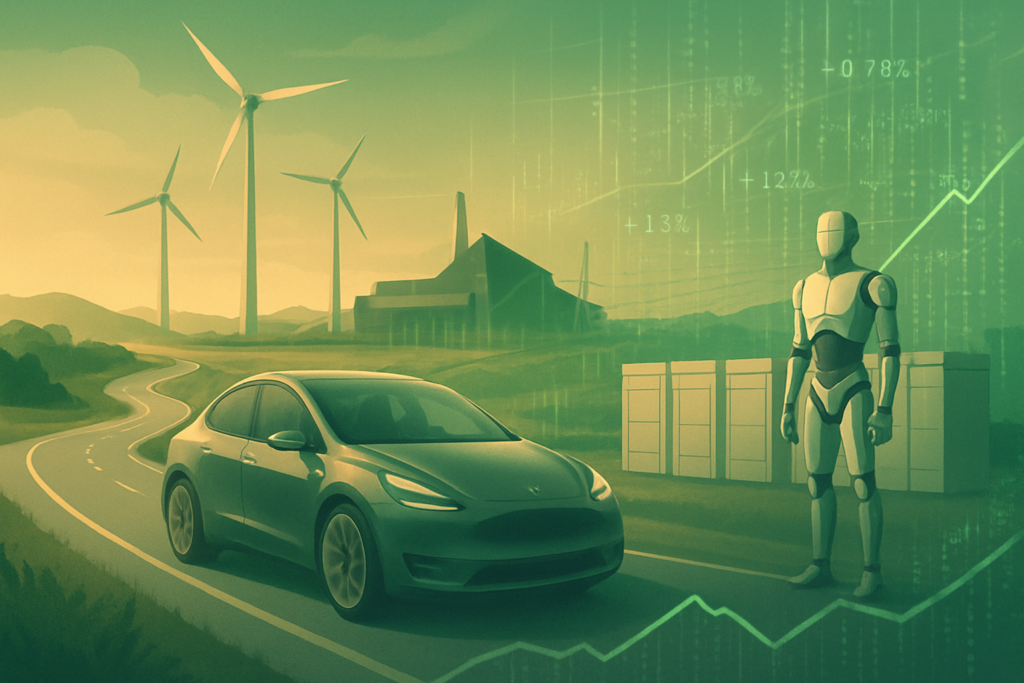
As of March 24, 2026, Tesla, Inc. (NASDAQ: TSLA) finds itself at a pivotal crossroads, navigating a landscape that looks vastly different from the unbridled growth years of the early 2020s. Once the undisputed monarch of the electric vehicle (EV) revolution, the Austin-based titan is currently grappling with a significant "European Slump"—a contraction in its most mature market that has sent shockwaves through the investment community.
While the company remains a central pillar of the global automotive and technology sectors, the narrative has shifted from "How many cars can Tesla build?" to "Can Tesla maintain its dominance in a saturated, hyper-competitive market?" With a valuation that remains pegged to its potential as an AI and robotics powerhouse rather than a traditional automaker, the pressure on CEO Elon Musk to deliver on the "Robotaxi" and "Optimus" promises has never been higher. This feature dives deep into the forces shaping Tesla’s current reality, from the factory floors of Giga Berlin to the high-stakes trading desks of Wall Street.
Historical Background
Tesla was founded in 2003 by Martin Eberhard and Marc Tarpenning, with Elon Musk joining shortly after as the lead investor. The company’s "Master Plan," famously penned by Musk in 2006, outlined a simple but audacious strategy: build a high-priced, low-volume sports car (the Roadster), use that money to build a mid-priced car (Model S and X), and finally use that revenue to create a high-volume, affordable car (Model 3 and Y).
For nearly two decades, Tesla defied the odds, surviving a "production hell" in 2017 and scaling to become the most valuable automaker in the world. Key milestones include the opening of Giga Shanghai in 2019, which transformed Tesla’s margins, and the 2022 opening of Giga Berlin and Giga Texas. However, the transition from a niche disruptor to a mass-market incumbent has brought a new set of challenges, particularly as the "S3XY" lineup (Models S, 3, X, and Y) begins to show its age against a flood of global competitors.
Business Model
Tesla operates a vertically integrated business model that spans several high-tech segments. While automotive sales remain the primary revenue driver, the company has diversified significantly:
- Automotive: Design, manufacturing, and sale of EVs. This includes the Model 3, the Model Y (the world’s best-selling car in 2023), and the controversial Cybertruck. In early 2026, Tesla officially phased out the Model S and Model X to focus on higher-volume platforms and AI-driven robotics.
- Energy Generation and Storage: This segment, featuring Powerwall, Megapack, and solar roof products, has become a "sleeper" hit, showing consistent double-digit growth as utilities transition to renewable grids.
- Services and Other: Revenue from Supercharging networks (now open to other brands), insurance, and software updates, including the Full Self-Driving (FSD) subscription.
- AI and Robotics: The frontier of Tesla’s valuation, focusing on the Dojo supercomputer, the "Cybercab" (Robotaxi), and the Optimus humanoid robot, which Tesla aims to deploy in its own factories by late 2026.
Stock Performance Overview
Tesla’s stock performance has been a roller coaster for long-term investors.
- 10-Year Horizon: Investors who held since 2016 have seen astronomical gains, outperforming the S&P 500 by over 1,000% as Tesla scaled from a niche player to a global leader.
- 5-Year Horizon: The performance is more nuanced, characterized by the massive 2020-2021 surge followed by extreme volatility.
- 1-Year Horizon (2025–2026): The past 12 months have been difficult. After a rebound in late 2024, the stock faced downward pressure throughout 2025 as European sales figures disappointed. As of March 24, 2026, TSLA is trading in a range that reflects a tug-of-war between "AI bulls" and "Auto bears."
Financial Performance
The 2025 fiscal year was one of the most challenging in Tesla’s recent history. Total European registrations fell from approximately 326,000 units in 2024 to roughly 235,000 in 2025—a nearly 30% decline. This contraction has had a tangible impact on financial metrics:
- Revenue Growth: While Energy and Services have grown, automotive revenue stagnated in 2025 due to price cuts aimed at defending market share.
- Margins: Operating margins, once the envy of the industry at 17-18%, have compressed to the 10-12% range as the company battles a global price war.
- Valuation: Despite the sales slump, Tesla carries a trailing P/E ratio of approximately 300. This premium suggests that the market is valuing Tesla as a software/AI company rather than a car manufacturer, pricing in massive future earnings from autonomous fleets.
Leadership and Management
Elon Musk remains the polarizing figurehead of the company. His leadership style, characterized by "hardcore" work culture and a penchant for setting aggressive (and often missed) timelines, continues to both inspire and alienate.
In 2025 and early 2026, management has faced scrutiny regarding Musk’s "split focus" between Tesla, SpaceX, and X (formerly Twitter). The "Musk Effect" has become a documented risk factor in Europe, where some consumers in Germany and the UK have cited his political stances as a reason for switching to brands like BMW or BYD. The board of directors, largely seen as Musk-aligned, continues to prioritize the long-term AI vision over short-term automotive volume stability.
Products, Services, and Innovations
Tesla’s current product strategy is defined by the "Juniper" refresh of the Model Y, which entered production at Giga Berlin in January 2025. This update brought improved aerodynamics, a modernized interior, and longer range (up to 447 miles WLTP), providing a necessary "shot in the arm" for European sales.
Beyond cars, the Cybercab (a dedicated Robotaxi without a steering wheel) is the center of Tesla’s innovation pipeline. Regulatory hurdles remain, but Tesla has begun pilot programs in select U.S. cities. Additionally, the Optimus robot has moved into "Gen 3" testing, with Musk claiming it will be the most significant product in Tesla’s history, though commercial availability remains a multi-year horizon away.
Competitive Landscape
The "European Slump" is largely a story of competition. Tesla's share of the European BEV market fell from 16.8% in early 2024 to under 9% by late 2025.
- BYD (SZSE: 002594): The Chinese giant has become Tesla’s most formidable rival. In July 2025, BYD registered more vehicles in Europe than Tesla for the first month ever, leveraging its lower-priced Seagull and Atto 3 models.
- Legacy Automakers: BMW, Volkswagen, and Stellantis have narrowed the "software gap," offering compelling EV alternatives that appeal to traditional European tastes for luxury and build quality.
- Niche Players: Brands like Polestar and Rivian (NASDAQ: RIVN) continue to chip away at the premium segments Tesla once dominated.
Industry and Market Trends
The global EV market is entering a "chasm" phase. Early adopters have been served, and the mass market is proving more price-sensitive and wary of charging infrastructure. In Europe, the resurgence of hybrid vehicles has slowed pure BEV adoption.
Furthermore, the "software-defined vehicle" (SDV) trend is now mainstream. Tesla no longer has a monopoly on over-the-air (OTA) updates, as legacy manufacturers have revamped their electronic architectures to match Tesla’s agility.
Risks and Challenges
Tesla faces a trifecta of risks in 2026:
- Brand Erosion: The "Musk Effect" is particularly acute in Western Europe, where corporate social responsibility (CSR) heavily influences consumer choice.
- Product Aging: Despite the Juniper refresh, the fundamental design of Tesla’s fleet has remained largely unchanged for years, leading to "Tesla fatigue" in mature markets like Norway and California.
- Execution Risk: The valuation relies on FSD and Robotaxis. Any major safety failure or regulatory ban on autonomous driving would likely result in a massive de-rating of the stock.
Opportunities and Catalysts
Despite the headwinds, several catalysts could spark a TSLA resurgence:
- FSD Licensing: If Tesla can successfully license its FSD software to other automakers (as Musk has hinted), it would create a high-margin recurring revenue stream akin to Microsoft’s Windows.
- Energy Storage Alpha: The Megapack business is currently supply-constrained. As capacity ramps up at the Lathrop and Shanghai Megafactories, this segment could eventually rival the automotive business in profit.
- The "Model 2": Rumors of a sub-$25,000 vehicle (often called the Model 2) persist. A successful launch of this platform would be the key to reclaiming lost market share from Chinese rivals.
Investor Sentiment and Analyst Coverage
Wall Street is currently a house divided.
- The Bulls (e.g., Wedbush’s Dan Ives): Maintain price targets as high as $600, arguing that the 2025 slump is a "short-term pain for long-term AI gain."
- The Bears (e.g., GLJ Research): Point to the 30% drop in European sales as proof that Tesla is a "broken growth story," with some targets as low as $25, treating the AI claims as vaporware.
- The Consensus: Most analysts have settled in the $380-$410 range, maintaining a "Wait and See" approach regarding Robotaxi commercialization.
Regulatory, Policy, and Geopolitical Factors
Geopolitics are a double-edged sword for Tesla. In Europe, the EU’s anti-subsidy probe into Chinese EVs resulted in a 7.8% tariff on Tesla’s China-made exports (Giga Shanghai). While this is lower than the 35%+ tariffs faced by some Chinese brands, it still adds cost pressure.
Moreover, Tesla’s reliance on China for both production and sales remains a strategic vulnerability. Any escalation in trade tensions between the West and China could disrupt Tesla’s "Giga Shanghai" hub, which remains its most efficient factory.
Conclusion
Tesla enters the second quarter of 2026 as a company in transition. The "European Slump" is a sobering reminder that first-mover advantage is not a permanent moat. To justify its current valuation, Tesla must prove that it is more than just a car company; it must successfully pivot to a future defined by autonomous transportation and humanoid robotics.
For investors, the key metrics to watch over the next 12 months are Model Y Juniper delivery volumes in Europe, regulatory progress for the Cybercab pilot programs, and the growth rate of the Energy storage segment. While the risks of brand fatigue and fierce competition are real, Tesla’s history of defying skeptics suggests that betting against Musk’s "Master Plan" remains a high-stakes gamble.
This content is intended for informational purposes only and is not financial advice.