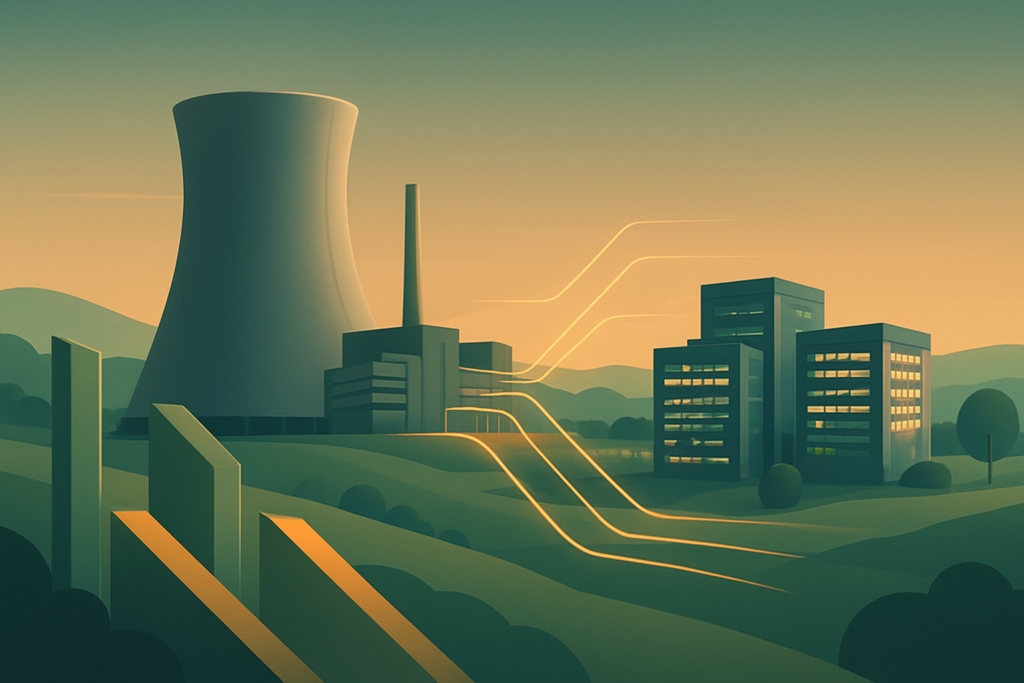
As of March 23, 2026, the intersection of heavy industry and high technology has a new epicenter: the American power grid. Among the titans of this transition, Vistra Corp. (NYSE: VST) has emerged not merely as a utility provider, but as a critical infrastructure partner for the global artificial intelligence (AI) revolution. Once viewed as a cyclical "legacy" power generator, Vistra has undergone a radical transformation, re-rating its valuation from a standard utility multiple to that of a high-growth technology enabler.
The catalyst for this shift is simple: AI requires an unprecedented, non-stop supply of carbon-free electricity. With the second-largest competitive nuclear fleet in the United States and a massive retail footprint, Vistra has positioned itself as one of the few entities capable of meeting the 24/7 energy demands of hyperscale data centers operated by the likes of Amazon and Meta. This article explores how Vistra moved from the ashes of the largest bankruptcy in history to become a top-performing S&P 500 constituent.
Historical Background
Vistra’s journey is a saga of American corporate resilience. Its roots trace back to Texas Utilities (TXU), the dominant power provider in North Texas for over a century. In 2007, TXU was the target of the largest leveraged buyout (LBO) in history—a $45 billion deal led by KKR and TPG. The new entity, Energy Future Holdings (EFH), bet heavily on high natural gas prices. However, the shale revolution sent gas prices plummeting, and by 2014, EFH was forced into a $40 billion bankruptcy.
In October 2016, Vistra Energy emerged from that bankruptcy as a standalone company, housing the generation assets (Luminant) and the retail arm (TXU Energy). Under the leadership of former CEO Curt Morgan, Vistra pivoted toward diversification. The 2018 merger with Dynegy expanded its footprint beyond Texas into the PJM and ISO-NE markets. The most pivotal moment in its recent history, however, occurred in March 2024 with the acquisition of Energy Harbor, which added three massive nuclear plants to its portfolio and solidified its transition toward a clean-energy future.
Business Model
Vistra operates an "integrated model" that creates a natural hedge against energy price volatility. The company is organized into two primary pillars:
- Vistra Vision: This is the company's "clean" growth engine. It includes the fleet of four nuclear power plants (Comanche Peak, Beaver Valley, Davis-Besse, and Perry), a growing portfolio of solar and battery storage assets (including the massive Moss Landing facility), and the retail business, which serves over 5 million residential, commercial, and industrial customers.
- Vistra Tradition: This segment contains the "dispatchable" fleet, primarily high-efficiency natural gas plants and a dwindling number of coal-fired units. This segment provides the "cash cow" revenue needed to fund dividends, buybacks, and the transition to cleaner energy.
By matching its generation capacity with its retail load, Vistra can sell power to its own customers, capturing the margin at both the production and sale levels while minimizing exposure to the swings of the wholesale spot market.
Stock Performance Overview
Over the last several years, Vistra’s stock performance has been nothing short of extraordinary.
- 1-Year Performance: As of March 2026, the stock has climbed approximately 45% over the trailing 12 months, fueled by landmark data center power purchase agreements (PPAs).
- 5-Year Performance: Vistra has been one of the top performers in the S&P 500, with a cumulative return exceeding 500%. This was driven by its 2024 "breakout" year, where the stock rose over 260% as the market realized the value of its nuclear assets.
- 10-Year Performance: Since emerging from bankruptcy in late 2016, Vistra has significantly outperformed both the S&P 500 and the Utilities Sector (XLU) index, evolving from a $15/share "distressed" play to a blue-chip infrastructure giant.
Financial Performance
Vistra’s financial health is currently at its strongest point in company history. In late 2025, the company achieved Investment-Grade (IG) credit ratings from S&P and Fitch, a milestone that has significantly lowered its cost of capital.
For the full year 2025, Vistra reported Adjusted EBITDA of $5.912 billion and Adjusted Free Cash Flow (FCF) of $3.592 billion. Looking ahead, management has issued robust 2026 guidance, projecting Adjusted EBITDA between $6.8 billion and $7.6 billion.
A cornerstone of the Vistra investment thesis is its aggressive capital allocation strategy. Since 2021, the company has repurchased nearly $6 billion in stock, reducing its total share count by over 30%. Management remains committed to a target of $16 FCF per share by 2027, a figure that underpins its current premium valuation.
Leadership and Management
The architect of Vistra’s modern era is Jim Burke, who took over as CEO in 2022. Burke, who previously served as CFO and COO, is widely regarded as one of the best capital allocators in the energy sector. His strategy, often called the "Burke Plan," focuses on operational excellence, strict financial discipline, and a "One Team" approach to integrating acquisitions like Energy Harbor and Cogentrix.
Under Burke, the management team has successfully navigated complex regulatory environments while maintaining a transparent relationship with shareholders. The board of directors is also noted for its focus on governance and aligning executive compensation with free cash flow and total shareholder return.
Products, Services, and Innovations
Vistra’s "product" is reliable, dispatchable power, but its innovations are found in how it delivers that power to a modern grid:
- Nuclear Fleet (The Crown Jewels): Vistra’s nuclear plants provide 6.4 GW of carbon-free, baseload power. In 2025, Vistra received 20-year license extensions for the Comanche Peak and Perry plants, ensuring these assets will generate cash flow well into the 2050s.
- Battery Storage: Vistra owns and operates the Moss Landing Power Plant in California, which houses one of the world's largest lithium-ion battery storage systems.
- Nuclear Uprates: Vistra is currently implementing "uprates"—technological upgrades to existing nuclear reactors—to squeeze an additional 400+ MW of capacity from its current fleet without building new plants.
Competitive Landscape
Vistra operates in a competitive independent power producer (IPP) market. Its primary rivals include:
- Constellation Energy (CEG): The largest operator of nuclear plants in the US. Constellation and Vistra are often traded in tandem as the "Nuclear/AI" duo.
- Talen Energy: A smaller competitor that set a precedent for the sector with its 2024 Amazon/AWS data center deal.
- NextEra Energy (NEE): While a traditional utility, NextEra competes for renewable energy market share, though it lacks Vistra’s competitive nuclear edge.
Vistra’s competitive advantage lies in its integrated retail model and its massive Texas (ERCOT) footprint, a market that is growing faster than almost any other in the nation.
Industry and Market Trends
Three macro trends are currently favoring Vistra:
- Electrification of Everything: The shift toward electric vehicles (EVs) and heat pumps is increasing baseline residential demand.
- AI Data Center Proliferation: Hyperscale data centers require enormous amounts of power that must be "always on." Traditional renewables (wind/solar) cannot provide this without massive storage, making nuclear and gas-fired power essential.
- Grid Fragility: As older coal plants retire, the reliability of the grid is being tested. Vistra’s dispatchable natural gas fleet (Vistra Tradition) has become more valuable as a "backup" to intermittent renewable sources.
Risks and Challenges
Despite its success, Vistra faces several headwinds:
- Regulatory Friction: In early 2025, the Federal Energy Regulatory Commission (FERC) increased scrutiny on "behind-the-meter" co-location deals, where data centers connect directly to power plants. While Vistra has navigated this with "front-of-the-meter" structures, regulatory changes remain a risk.
- Operational Risk: Nuclear power requires flawless safety execution. Any incident at a Vistra facility, or even a competitor's facility, could lead to a sector-wide re-evaluation.
- Commodity Exposure: While hedged, a significant portion of Vistra’s earnings still depends on natural gas and wholesale power prices.
Opportunities and Catalysts
- Meta and Amazon Deals: In early 2026, Vistra signed a landmark 20-year PPA with Meta (Facebook) for over 2,100 MW of nuclear energy. Similar deals with other "Magnificent Seven" tech firms are expected to follow.
- M&A Potential: Following its early 2026 acquisition of Cogentrix, Vistra is well-positioned to acquire smaller gas and renewable portfolios as utilities seek to divest non-core assets.
- Tax Credits: The Inflation Reduction Act (IRA) provides significant production tax credits (PTCs) for existing nuclear plants, providing a floor for Vistra’s nuclear earnings.
Investor Sentiment and Analyst Coverage
Wall Street sentiment toward Vistra is overwhelmingly bullish. Analysts have largely moved away from valuing VST as a "boring utility" and now categorize it as an "AI Infrastructure" play. Major firms, including Morgan Stanley and Goldman Sachs, maintain "Overweight" or "Buy" ratings, with price targets reflecting the company's ability to generate $16+ in FCF per share. Institutional ownership remains high, with significant positions held by Vanguard, BlackRock, and several prominent value-oriented hedge funds.
Regulatory, Policy, and Geopolitical Factors
The U.S. government’s push for energy independence and decarbonization is a tailwind for Vistra. The Nuclear Regulatory Commission (NRC) has shown a renewed willingness to extend plant licenses to ensure grid stability. Furthermore, the bipartisan support for nuclear power as a "national security asset" in the face of rising global energy competition provides Vistra with a favorable political moat. However, the company must continue to navigate the complex rules of regional grid operators like PJM and ERCOT, where market design changes can impact profitability.
Conclusion
Vistra Corp. has successfully transitioned from a legacy power generator to a cornerstone of the modern digital economy. By leveraging its massive nuclear fleet and an integrated business model, it has solved the most pressing problem for the AI industry: the need for reliable, carbon-free, baseload power.
For investors, Vistra offers a unique combination of utility-like stability and tech-like growth. While regulatory hurdles and operational risks remain, the company’s aggressive share buybacks and robust free cash flow generation provide a significant margin of safety. As we look toward the remainder of 2026 and beyond, Vistra’s ability to "power the future" makes it a compelling study in corporate transformation.
This content is intended for informational purposes only and is not financial advice.