Introduction
In today’s digital-first world, the reliability of physical infrastructure often determines the success of entire industries. From hyperscale data centers powering cloud services to cranes lifting tons of material at construction sites, cables are the unsung heroes. Two categories stand out for their importance: data center power cables and crane cables. While they serve vastly different environments, both are engineered to withstand demanding conditions and ensure uninterrupted operations.
Data Center Power Cables: Backbone of Digital Infrastructure
Why They Matter
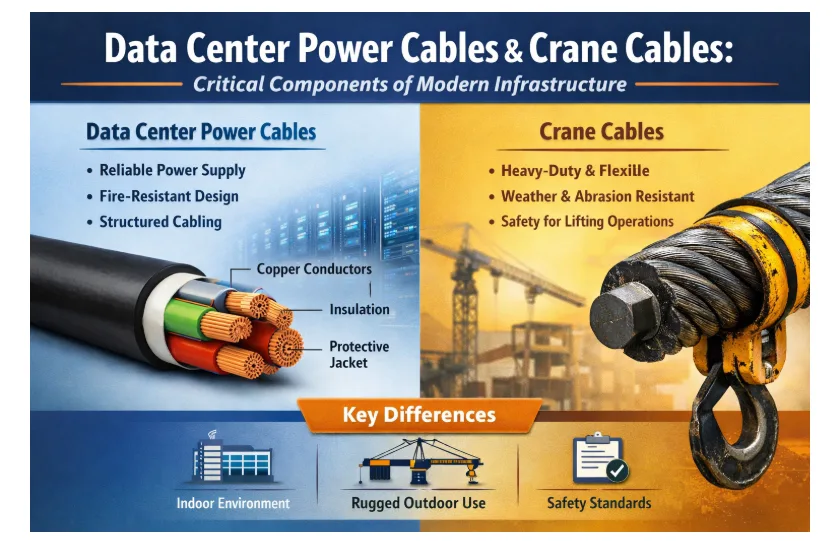
Data centers are the nerve centers of global connectivity. Every server, switch, and cooling system depends on a stable power supply. Data center power cables are designed to deliver consistent electricity while minimizing risks of overheating, downtime, or fire hazards.
- Reliability: Case studies show that improper cable terminations can lead to catastrophic downtime. For example, one U.S. data center experienced unexpected outages due to cable disintegration, later resolved through Tan Delta testing and compliance with NETA MTS-2023 standards (veearc.com).
- Efficiency: Proper cable management improves airflow, reduces troubleshooting time, and enhances safety compliance (ResearchGate).
Industry Standards
- ANSI/TIA-942 and ISO/IEC 24764 provide guidelines for structured cabling.
- NETA MTS-2023 mandates periodic testing to ensure cable integrity.
Case Study
A large enterprise data center streamlined its cable deployment by implementing rigorous NETA testing. This included checks for continuity, insulation resistance, and phasing, ensuring flawless installation and reducing risk of downtime for Quad Plus.
Crane Cables: Powering Heavy-Duty Operations
Unique Challenges
Unlike data centers, cranes operate in rugged environments—construction sites, ports, and manufacturing plants. Crane cables must endure mechanical stress, bending, and exposure to weather.
- Durability: Designed to withstand constant flexing and heavy loads.
- Safety: Essential for preventing accidents in lifting operations.
Market Insights
The global crane cables market is projected to grow steadily, driven by infrastructure development and industrialization. Reports forecast a CAGR of 7.7% between 2026 and 2033, highlighting increasing demand for advanced cable technologies on LinkedIn.
Applications
- Festoon systems for overhead cranes.
- Reeling cables for mobile cranes.
- Pendant cables for control systems.
Comparing Data Center Power Cables and Crane Cables
| Feature | Data Center Power Cables | Crane Cables |
| Environment | Controlled indoor, climate-regulated | Outdoor, rugged, variable weather |
| Primary Function | Stable electricity distribution | Mechanical lifting and power transmission |
| Key Standards | ANSI/TIA-942, NETA MTS-2023 | IEC standards, OSHA safety compliance |
| Failure Risks | Downtime, overheating, fire | Accidents, load drops, equipment damage |
| Testing Frequency | Every 36 months (NETA) | Continuous inspection due to wear |
Best Practices for Reliability
For Data Centers
- Implement structured cabling with clear labeling.
- Conduct periodic VLF withstand and tan delta testing.
- Use high-quality copper or fiber cables with fire-resistant jackets.
For Cranes
- Regularly inspect cables for wear and tear.
- Employ festoon systems to reduce mechanical stress.
- Choose cables with reinforced insulation for outdoor durability.
Conclusion
Whether in a data center ensuring uptime for millions of users or a crane lifting tons of steel at a construction site, cables are mission-critical. Investing in high-quality data center power cables and crane cables is not just about compliance—it’s about safeguarding productivity, safety, and trust. As industries evolve, the demand for advanced cable technologies will only grow, making them indispensable to modern infrastructure.