The 3D reconstruction of the seventh wonder of the world uncovers an ancient engineering masterpiece of unexpected modernity
More than 2,000 years after it was built, the legendary lighthouse of Alexandria is being brought back to life through scientific research and the use of virtual universes. For the first time, a scientifically complete 3D reconstruction reveals how one of the Seven Wonders of the World was built.
This press release features multimedia. View the full release here: https://www.businesswire.com/news/home/20261119013134/en/
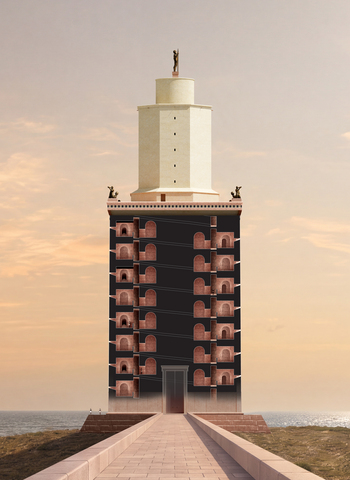
Image F. Monnier ©Isabelle Hairy – CNRS – CEAlex – La Fondation Dassault Systèmes GEDEON Programmes
Rising some 100 meters above the Mediterranean, this masterpiece of civil engineering dominated the coastline for nearly 16 centuries and withstood 18 earthquakes before its light went out. Its last mysteries are now being solved by research led by the Centre d’Études Alexandrines (CEAlex, CNRS/Institut français d’archéologie orientale) and CNRS archaeologist and architect Isabelle Hairy, with the support of La Fondation Dassault Systèmes and GEDEON Programmes.
“Working for 30 years on the underwater excavation of the Pharos, the first skyscraper in human history, has been a blessing. With the Pharos project, we can finally begin to explain this highly sophisticated architecture built at the entrance to Alexandria on the Mediterranean,” said Hairy, director of the lighthouse’s underwater excavation since 1997 and of the Pharos project.
Since the first underwater excavation in 1995, CEAlex has continued its work at the site, now regarded as the largest submerged architectural site in the world. To date, 4,896 stone blocks and nearly 3,000 fragments of construction metals have been recorded at depths of 4 to 9 meters, across an area of about 2 hectares.
In June 2025, its teams raised the largest blocks from the waters of Alexandria’s harbor, including the lintel and jambs of the monumental door, weighing 70 to 80 tons, its threshold, large slabs weighing up to 40 tons, base elements reused from the pyramids of Egypt’s Old Kingdom, and fragments of a previously unknown monument: an Egyptian-style pylon built using Greek techniques.
These finds deepened the understanding of the site and opened new avenues of research into the architectural choices and technical influences behind such massive structures, but archaeological evidence alone could not support a reconstruction since the underwater site represents less than 10% of the original structure.
To fill the gaps, a multidisciplinary team brought together through the Pharos project catalogued sources describing the monument including coins, terracotta lamps, mosaics and engraved glass, as well as medieval Arabic documentation that describes the lighthouse’s architecture with remarkable precision.
The challenge was to understand how the structure was actually built. Isabelle Hairy and volunteer engineers from La Fondation Dassault Systèmes combined their expertise to reconstruct the lighthouse by using 3D technologies.
The teams cross-checked all available data, integrated it into a 3D model, and tested each hypothesis until the results converged on a complete reconstruction. This also made it possible to simulate and assess the structure’s mechanical strength during earthquakes, and explain how the lighthouse endured for 16 centuries.
Hairy and the engineers compared their analyses using the 1:1 Teleport, an immersive space designed by Dassault Systèmes that allowed them to step inside a full-scale virtual model, explore it and refine the reconstruction. The reconstruction clarified both structure and setting, highlighting the following features:
- Exterior: a rising causeway supported by 16 arches, a monumental entrance 13 meters high, and three distinct volumes, proportioned according to harmonic ratios, set on a solid base
- Interior: 67 rooms spread across 9 levels, connected by a ramp wide enough for two horsemen to pass each other, an alternative route through the interconnected rooms via staircases situated on a separate level; a surprising layout which visitors have described as labyrinthine; and a structure supported by superimposed arcades and vast vaulted halls, revealing an unexpected level of technical modernity.
“The Lighthouse of Alexandria was a masterpiece of civil engineering that survived 18 earthquakes. That technical feat is what led La Fondation Dassault Systèmes to join this project. The 3D reconstruction and simulations created by Isabelle Hairy and our engineers, who contributed through skills-based volunteering, have helped us understand how the monument was designed. They have also given it a second life by making a virtual visit possible,” said Thibault de Tersant, President, La Fondation Dassault Systèmes.
###
About La Fondation Dassault Systèmes
La Fondation Dassault Systèmes supports transformative, public-interest projects in education, research and heritage that leverage virtual worlds. Its mission is to spark young people’s interest in science and technology, inspire them to pursue careers in these fields and help students build the skills they’ll need for tomorrow. It also supports innovative scientific research and heritage projects to push the boundaries of knowledge. Beyond funding, La Fondation Dassault Systèmes engages a network of employee volunteers to share their expertise, helping partners bring their projects to life and explore new possibilities. It operates through three foundations in Europe, India and the United States. www.lafondation3ds.org
About the CNRS
A major player in fundamental research worldwide, the French National Centre for Scientific Research (CNRS) is the only French research organisation active across all scientific disciplines. Its unique position as a multidisciplinary organisation enables it to bring together different fields of science to shed light on and address the challenges facing the contemporary world, working closely with public and socio-economic stakeholders. Together, the sciences contribute to sustainable progress that benefits society as a whole.
View source version on businesswire.com: https://www.businesswire.com/news/home/20261119013134/en/
Contacts
Media
Dassault Systèmes: Arnaud MALHERBE arnaud.malherbe@3ds.com +33 (0)1 61 62 87 73
CNRS: Estelle TORGUE estelle.torgue@cnrs.fr