Most observers will likely jump to the conclusion that tech giant Oracle (ORCL) is heavily discounted and for understandable reasons. Fundamentally, the company ranks as one of the most important players in artificial intelligence. Quantitatively, ORCL stock currently trades at under 25 times trailing earnings, well below the 52x multiple seen in August 2025.
Still, such observations are rather ordinal; that is, the low price-earnings (PE) ratio is labeled as such relative to a ratio that was higher at some point in the past. My concern with ordinal analyses is that the valuation comparison assumes a premise that may or may not be justified. In this case, ORCL stock is perceived to be a discount due to a price indicator.
Here’s the issue, though. Price is not necessarily an effective mechanism to judge value in publicly traded equities. This statement may sound almost blasphemous within financial circles but there’s a clear logic behind the claim.
ORCL Stock Does Not Have a Fixed Utility
One of the most important elements within market valuation is that tradable securities (outside of rare exceptions like thinly traded over-the-counter tickers) do not have fixed utility. As such, comparing current price points relative to historical is an unreliable mechanism to find value.
Consider the example of an off-price department store. Typically, some products end up collecting dust in mainline retail stores due to a variety of reasons. Maybe they didn’t resonate with consumers’ tastes or perhaps the manufacturers made too many units. Whatever the case, it’s better to dump the excess inventory with discount specialists at a reduced rate than to trash the products altogether.
Obviously, the business model of off-price retailers works because the underlying utility is fixed. A T-shirt covers the upper body, a frying pan cooks food. Just because these items aren’t fashionably desirable doesn’t mean they don’t work. So, if you can get these fixed-utility items at, say, a 30% discount, that’s a legitimately good deal.
However, the same logic cannot be applied automatically to ORCL stock or any other tradable security; the utility isn’t fixed. Instead, the utility — which in the case of stocks is analogous to the forward expectation of their trajectory — constantly shifts. In other words, if we are to apply the principles of fundamental analysis in assessing value, we must study value relative to the underlying state.
The Importance of Conditioning Our Analysis
As mentioned above, ORCL stock trades at under 25x trailing-year earnings (24.79x if we’re being precise). Since this ratio is below prior ratios, ORCL may be labeled as discounted. However, this observation ignores the state that the stock is currently in. As such, the observation is unconditioned.
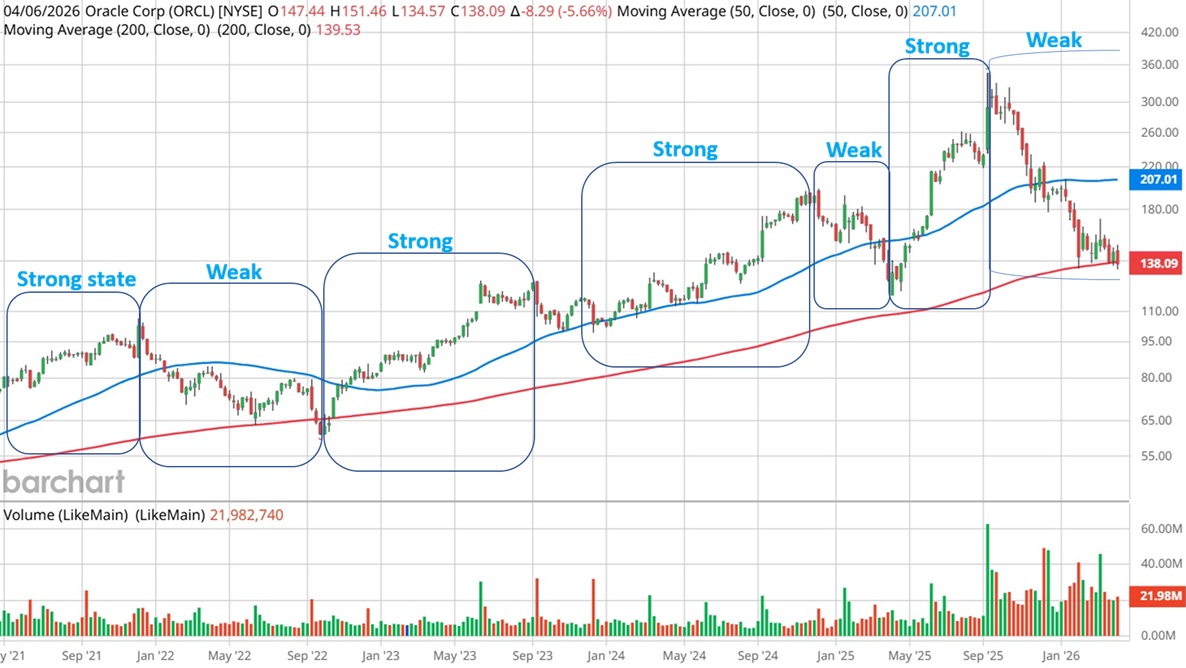
In my view, fundamental analysis is much more effective when we break down a security based on state categories. For the trailing five-year chart of ORCL stock, I broke down its price action into seven states (either Strong or Weak). Further, based on this state-based conditioned observation, ORCL remains stuck in a Weak state.
Subsequently, we’re not just talking about a security that trades at 24.79-times earnings; we’re instead talking about a 24.79x multiple that’s in a Weak state. Moreover, this current figure sits lower than the troughs of the Weak buckets, which roughly come in at 24.84x, 38.46x and 26.01x.
It’s a Discount with a Caveat
For those who are looking for a potentially viable entry into ORCL stock, it’s difficult to ignore the current valuation. It’s not just low based on some unconditioned historical benchmark; it’s actually low relative to bottom points seen in ORCL’s recent Weak behavioral states.
That said, it’s important to approach Oracle with eyes wide open. While the security could be at the tail end of a Weak state, there’s nothing that absolutely guarantees that ORCL stock will not fall further. After all, the prior states (whether Weak or Strong) occurred within a pre-Iran war regime. Since there’s no playbook for a post-Iran war regime, it’s incredibly difficult to pinpoint how long behavioral states can last.
Still, if we’re looking at this tech giant from an inductive perspective, the current deal is tempting.
On the date of publication, Josh Enomoto did not have (either directly or indirectly) positions in any of the securities mentioned in this article. All information and data in this article is solely for informational purposes. For more information please view the Barchart Disclosure Policy here.
More news from Barchart