The waste to energy (WTE) market is witnessing strong growth as governments, utilities, and renewable energy generation, and sustainable waste management requirements across global markets.
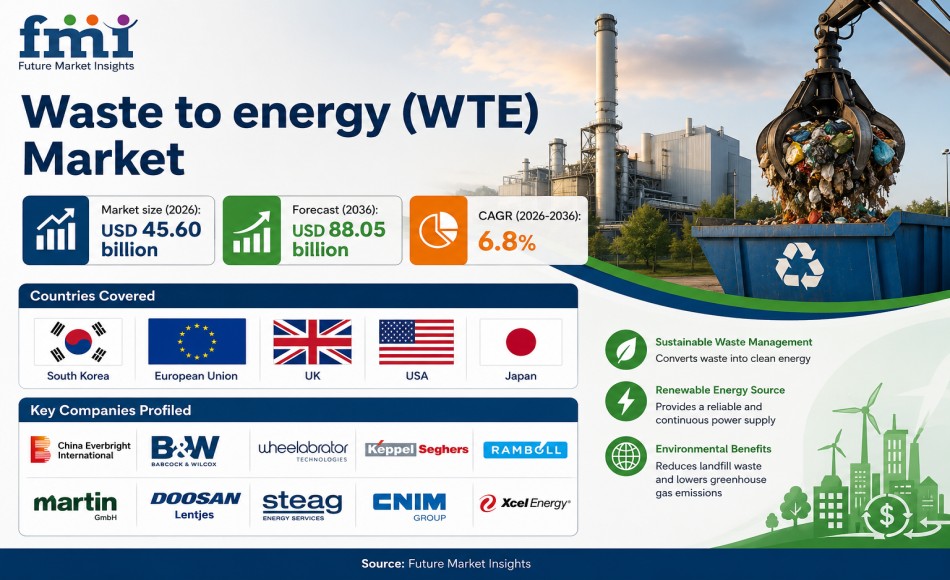
NEWARK, DE / ACCESS Newswire / May 22, 2026 / According to the latest market analysis by Future Market Insights, the global waste to energy (WTE) market , valued at USD 45.60 billion in 2026 and projected to reach USD 88.05 billion by 2036, is emerging as a rapidly expanding energy recovery and waste management segment supported by rising infrastructure investment, tightening environmental regulations, and growing institutional adoption of advanced waste processing technologies.
As municipalities and industries continue to prioritize landfill diversion, renewable energy generation, and sustainable waste disposal systems, demand for waste to energy solutions continues to accelerate across both developed and emerging economies. Technology providers and infrastructure operators are increasingly focusing on efficiency optimization, regulatory compliance, digital monitoring systems, and large-scale facility expansion to strengthen operational performance and long-term adoption.
Quick Stats Snapshot
Market size (2026): USD 45.60 billion
Forecast (2036): USD 88.05 billion
CAGR (2026-2036): 6.8%
Incremental opportunity: USD 42.45 billion
Fastest-growing region: South Korea (6.5% CAGR)
Leading waste type: Solid Waste (69% share by 2026)
Leading process segment: Anaerobic Digestion
Leading applications: Electricity and Transport Fuels
Key end users: Municipal Authorities and Energy Utilities
Get detailed market forecasts, competitive benchmarking, and pricing trends: https://www.futuremarketinsights.com/reports/sample/rep-ap-299
Market Size and Growth Outlook
The waste to energy (WTE) market is projected to grow from USD 45.60 billion in 2026 to USD 88.05 billion by 2036, reflecting a CAGR of 6.8%.
Growth is being driven by increasing municipal solid waste generation, stricter environmental regulations, rising renewable energy demand, and expanding infrastructure investments in sustainable waste management systems.
Growth Drivers: Infrastructure Investment and Sustainable Energy Demand
1. Rising Demand for Landfill Diversion and Sustainable Waste Management
Governments and municipalities are increasingly adopting waste to energy technologies to reduce landfill dependency, improve waste processing efficiency, and meet environmental sustainability targets.
2. Expansion of Renewable Energy and Circular Economy Initiatives
Waste to energy facilities are supporting renewable electricity and fuel generation by converting municipal solid waste, industrial waste, and biomass into usable energy resources.
3. Regulatory Support and Institutional Procurement Growth
Environmental regulations and waste management mandates across major economies are accelerating procurement of advanced waste conversion technologies and infrastructure modernization.
Key Challenges: High Capital Costs and Technology Complexity
Despite strong growth momentum, the market continues to face several operational and adoption-related challenges:
High infrastructure and equipment investment requirements
Complex regulatory compliance procedures
Technology integration and operational efficiency challenges
Public concerns regarding emissions and environmental impact
Long project approval and implementation timelines
Emerging Opportunities: Technology Innovation and Procurement Modernization
The market is witnessing increasing innovation across waste processing technologies, energy efficiency systems, and digital operational management:
Expansion of anaerobic digestion and gasification facilities
Growth of smart monitoring and AI-enabled operational systems
Rising investment in advanced emissions control technologies
Increasing adoption of direct supply and digital procurement models
Expansion of energy recovery infrastructure in emerging markets
Segmentation Insights: Solid Waste and Anaerobic Digestion Lead Demand
By Waste Type:
Solid Waste is expected to account for 69% share in 2026, supported by strong municipal waste management demand and increasing landfill diversion initiatives globally.
By Process:
Anaerobic Digestion leads the process segment due to growing institutional adoption and increasing focus on organic waste conversion and renewable gas production.
By Application:
Electricity generation remains a dominant application area, while transport fuels continue to gain momentum through biofuel and alternative energy initiatives.
By End Use:
Municipal Authorities and Energy Utilities continue to drive large-scale procurement and infrastructure investment across key regions.
Customize insights for your business strategy: https://www.futuremarketinsights.com/customization-available/rep-ap-299
Regional Analysis: South Korea and European Union Drive Growth Momentum
South Korea (6.5% CAGR):
Infrastructure investment, regulatory enforcement, and expanding waste processing capacity are accelerating adoption of advanced waste to energy technologies.
European Union (6.2% CAGR):
Strong environmental regulations and circular economy initiatives continue to support procurement growth and infrastructure modernization.
United Kingdom (6.0% CAGR):
Technology adoption and institutional investments in sustainable waste management systems are strengthening market expansion.
United States (5.8% CAGR):
Renewable energy initiatives, municipal infrastructure upgrades, and landfill diversion programs are supporting steady growth.
Japan (5.5% CAGR):
High urban density and advanced waste management systems continue to drive demand for efficient waste conversion technologies.
Competitive Landscape: Infrastructure Scale and Technology Expertise Shape Competition
The market remains moderately consolidated, with global infrastructure operators and technology providers competing through operational scale, process innovation, and regulatory compliance capabilities.
Key players include:
China Everbright International
Babcock & Wilcox Enterprises
Wheelabrator Technologies
Keppel Seghers
Ramboll Group
Martin GmbH
Doosan Lentjes
Competition is increasingly influenced by infrastructure scale, technology efficiency, regulatory compliance expertise, and long-term institutional procurement relationships.
Strategic Implications for Industry Leaders
For waste management operators, infrastructure developers, and energy technology providers, key priorities include:
Expanding advanced waste conversion infrastructure
Strengthening emissions compliance and operational efficiency
Enhancing digital procurement and monitoring capabilities
Supporting long-term municipal and institutional partnerships
Improving energy recovery efficiency and sustainability positioning
Future Outlook: Toward Integrated Sustainable Energy Recovery Systems
The waste to energy (WTE) market is expected to evolve into a critical component of global sustainable infrastructure driven by renewable energy demand, landfill reduction goals, and growing circular economy initiatives.
Key future trends include:
Expansion of gasification and pyrolysis technologies
Growth of AI-enabled plant optimization systems
Increasing investment in renewable fuel production
Rising adoption of advanced emissions control infrastructure
Greater integration of waste to energy systems into smart city initiatives
Unlock 360° insights for strategic decision-making and investment planning: https://www.futuremarketinsights.com/checkout/299
Executive Takeaways
Market expected to reach USD 88.05 billion by 2036 at 6.8% CAGR
Solid Waste remains the leading waste type segment
Anaerobic Digestion continues to lead process adoption
South Korea and European Union drive regional growth momentum
Infrastructure investment and regulatory support accelerate adoption
Competitive advantage increasingly depends on operational scale, compliance expertise, and technology efficiency
In an increasingly sustainability-focused energy and waste management environment, companies that invest in advanced conversion technologies, infrastructure modernization, regulatory compliance, and institutional partnerships will be best positioned to strengthen market share and capitalize on long-term growth opportunities in the global waste to energy (WTE) industry.
Related Reports:
Subsea Filter Separators Market: https://www.futuremarketinsights.com/reports/subsea-filter-separators-market
Tension Leg Platforms (TLP) Market: https://www.futuremarketinsights.com/reports/tension-leg-platforms-tlp-market
Decoking Control System Market: https://www.futuremarketinsights.com/reports/decoking-control-system-market
Compressor Anti Surge Control Valve Market: https://www.futuremarketinsights.com/reports/compressor-anti-surge-control-valve-market
Surfactants for Enhanced Oil Recovery (EOR) Market: https://www.futuremarketinsights.com/reports/surfactants-for-enhanced-oil-recovery-eor-market
About Future Market Insights (FMI)
Future Market Insights (FMI) is a leading provider of market intelligence and consulting services, serving clients in over 150 countries. Headquartered in Delaware, USA, with a global delivery center in India and offices in the UK and UAE, FMI delivers actionable insights to businesses across industries including automotive, technology, consumer products, manufacturing, energy, and chemicals.
An ESOMAR-certified research organization, FMI provides custom and syndicated market reports and consulting services, supporting both Fortune 1,000 companies and SMEs. Its team of 300+ experienced analysts ensures credible, data-driven insights to help clients navigate global markets and identify growth opportunities.
For Press & Corporate Inquiries:
Rahul Singh
AVP - Marketing and Growth Strategy
Future Market Insights, Inc.
+91 8600020075
For Sales - sales@futuremarketinsights.com
For Media - Rahul.singh@futuremarketinsights.com
For web - https://www.futuremarketinsights.com/
For Web - https://www.factmr.com/
SOURCE: Future Market Insights, Inc.
View the original press release on ACCESS Newswire