The fast food bag market is evolving into a sustainability-driven packaging segment focused on compliance, branding, operational efficiency, and scalable procurement reliability.
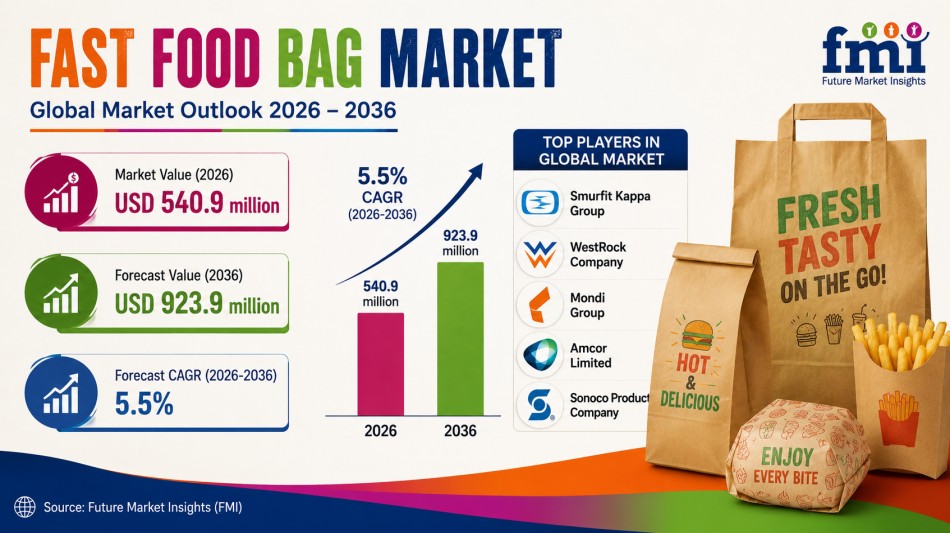
NEWARK, DE / ACCESS Newswire / May 21, 2026 / According to the latest market analysis by Future Market Insights, the fast food bag market is transitioning from a conventional foodservice packaging category into a specification-driven procurement segment aligned with sustainability, compliance, and operational efficiency goals. Valued at USD 512.7 million in 2025 and projected to reach USD 540.9 million in 2026, the market is expected to expand at a CAGR of 5.5% during the forecast period, ultimately reaching USD 923.9 million by 2036.
This growth reflects a structural shift in packaging procurement practices as restaurants, cafés, bakeries, and organized foodservice operators increasingly prioritize certified, recyclable, and performance-oriented packaging solutions over low-cost commodity alternatives.
Quick Stats at a Glance
Market size (2025): USD 512.7 million
Estimated value (2026): USD 540.9 million
Forecast (2036): USD 923.9 million
CAGR (2026-2036): 5.5%
Incremental opportunity: USD 383 million
Leading material type: Brown Kraft (82.0% share)
Leading application: Hotels, Restaurants and Cafes (66.1% share)
Fastest-growing market: India (7.5% CAGR)
Strong growth markets: China (6.7%), USA (5.4%), Japan (5.0%)
Get detailed market forecasts, competitive benchmarking, and pricing trends:
https://www.futuremarketinsights.com/reports/sample/rep-gb-18178
Market Size and Structural Shift
The fast food bag market is entering a long-term expansion cycle supported by evolving procurement standards and sustainability-focused packaging strategies.
Historically, purchasing decisions in foodservice packaging were largely driven by price and volume efficiency. That model is changing. Large restaurant chains, institutional foodservice operators, and organized retail networks are now emphasizing product quality, environmental compliance, supply reliability, and brand alignment.
Fast food bags are increasingly viewed not merely as disposable carriers, but as functional brand extensions capable of supporting food safety, grease resistance, sustainability positioning, and customer experience objectives.
As procurement systems become more centralized, suppliers capable of delivering standardized quality across regions are expected to gain competitive advantage.
Growth Drivers: Sustainability, Procurement Consolidation, and Regulatory Compliance
Three major forces are accelerating market expansion across global foodservice ecosystems.
1. Sustainability-Led Packaging Transition
Governments and corporate buyers are intensifying focus on recyclable and biodegradable packaging materials. Brown kraft bags, in particular, are gaining widespread adoption due to their recyclability, lower environmental impact, and alignment with plastic-reduction initiatives.
Foodservice operators are increasingly replacing conventional plastic-based alternatives with paper-based packaging formats that support ESG commitments and regulatory compliance.
2. Consolidation of Procurement Networks
Large restaurant groups and institutional buyers are consolidating vendor networks to improve cost control and supply consistency. This shift favors manufacturers with integrated production capacity, broad product portfolios, and multi-regional distribution infrastructure.
Suppliers capable of ensuring consistent quality and uninterrupted supply across multiple markets are becoming preferred procurement partners.
3. Expansion of Organized Foodservice
Rapid urbanization and growth of organized food delivery ecosystems are driving consumption of fast food packaging products. Quick-service restaurants, cafés, cloud kitchens, and bakery chains continue expanding across emerging economies, creating sustained demand for standardized packaging solutions.
Market Constraints: Cost Pressures and Margin Compression
Despite favorable growth fundamentals, the industry faces several operational challenges.
Raw material price volatility remains a major concern, particularly for kraft paper and related packaging substrates. Fluctuating pulp and transportation costs continue to pressure supplier margins.
At the same time, intense competition within commodity packaging categories limits pricing flexibility. Buyers increasingly demand higher-performance packaging without proportionate price increases.
Compliance requirements also add operational complexity. Environmental labeling standards, food-contact safety regulations, and certification requirements are increasing the cost burden for smaller manufacturers lacking scale advantages.
As a result, manufacturers with vertically integrated operations and regional production networks are expected to outperform fragmented competitors.
Opportunity Landscape: Where Future Value Is Emerging
Several high-impact opportunities are reshaping the competitive landscape:
Sustainable fiber-based packaging innovations enabling stronger environmental positioning
Expansion of organized food delivery platforms increasing demand for standardized carry packaging
Growth of premium branded takeaway packaging for cafés and specialty restaurants
Regional manufacturing expansion reducing logistics costs and supply chain disruptions
Product customization and print integration supporting brand visibility and customer engagement
Manufacturers that combine sustainability compliance with scalable production efficiency are expected to capture disproportionate market share through the forecast period.
Segment Insights: Where the Market Is Concentrated
By Material Type
Brown kraft dominates the market with an 82.0% share, supported by widespread foodservice adoption, recyclability advantages, and established procurement preferences.
Its durability, grease resistance, and compatibility with sustainability mandates continue to reinforce its leadership position across commercial food packaging applications.
Other material categories including polypropylene, plant fiber, disposable foam, and white kraft maintain niche demand across specialized applications.
By Application
Hotels, Restaurants and Cafes account for 66.1% of total demand, reflecting procurement concentration within organized foodservice channels.
Growth in this segment is driven by increasing takeaway consumption, food delivery expansion, and procurement standardization among restaurant chains and hospitality operators.
Additional demand is emerging from grocery stores, bakeries, candy stores, and gift shops seeking cost-efficient and customizable packaging formats.
Speak to Analyst: Customize insights for your business strategy:
https://www.futuremarketinsights.com/customization-available/rep-gb-18178
Regional Dynamics: Emerging Markets Lead Expansion
Growth patterns vary significantly across global regions, though Asia remains the primary demand engine.
India (7.5% CAGR): India is projected to lead global growth through 2036, supported by rapid expansion of organized foodservice networks, urban retail infrastructure, and distribution formalization.
China (6.7% CAGR): China continues to benefit from large-scale manufacturing capacity, strong supply chain integration, and tightening environmental regulations encouraging sustainable packaging adoption.
United States (5.4% CAGR): The U.S. market is supported by replacement demand, food delivery growth, and increasing sustainability compliance requirements among restaurant operators and institutional buyers.
Japan (5.0% CAGR): Japan's market growth reflects demand for high-specification, quality-assured packaging products aligned with stringent procurement standards.
Australia (4.1% CAGR): Australia represents a mature but steadily evolving market characterized by sustainability upgrades and regulatory modernization.
Competitive Landscape: Scale and Supply Reliability Matter Most
Competition in the fast food bag market is increasingly centered on manufacturing scale, procurement consistency, and regional distribution capabilities rather than simple price competition.
Leading players including Smurfit Kappa Group, WestRock Company, Mondi Group, Amcor Limited, and Sonoco Products Company are strengthening market positions through:
Integrated manufacturing infrastructure
Broad product portfolios
Multi-regional distribution networks
Sustainability-certified packaging solutions
Operational scale and procurement reliability
Meanwhile, regional and niche players are targeting underserved application segments through customized product development and localized supply capabilities.
Strategic Implications for Industry Stakeholders
For manufacturers, future competitiveness will increasingly depend on operational scale, compliance readiness, and supply chain resilience.
For restaurant chains and institutional buyers, supplier selection criteria are shifting toward consistency, sustainability credentials, and total cost efficiency rather than lowest upfront pricing.
For investors, the market presents opportunities across sustainable packaging innovation, regional manufacturing expansion, and integrated distribution ecosystems.
For procurement leaders, long-term supplier partnerships are becoming critical as environmental standards and compliance obligations continue to tighten globally.
Future Outlook: From Commodity Packaging to Strategic Procurement
Over the next decade, the fast food bag market is expected to evolve from a price-sensitive packaging category into a strategically managed procurement segment integrated with broader sustainability and operational efficiency goals.
Key trends expected to shape the market include:
Wider adoption of recyclable and fiber-based packaging materials
Increased procurement consolidation among foodservice operators
Growth of branded and customized takeaway packaging formats
Expansion of regional manufacturing hubs for supply resilience
Rising integration of sustainability compliance into procurement frameworks
As these trends mature, competitive advantage will increasingly depend on manufacturing reliability, certification capability, and scalable distribution infrastructure.
Unlock 360° insights for strategic decision making and investment planning-
https://www.futuremarketinsights.com/checkout/18178
Executive Takeaways
The fast food bag market is transitioning from volume-based purchasing toward specification-driven sourcing.
Sustainability mandates and procurement consolidation are reshaping competitive dynamics.
Brown kraft remains the dominant material due to recyclability and broad end-use compatibility.
Emerging markets, particularly India and China, are driving long-term demand expansion.
Manufacturers with integrated supply chains and multi-regional distribution are best positioned for growth.
Future market leadership will depend on compliance readiness, operational resilience, and sustainable product innovation.
Related Reports:
Fast Food Containers Market: https://www.futuremarketinsights.com/reports/fast-food-containers-market
Food Bags Market: https://www.futuremarketinsights.com/reports/food-bags-market
Food Storage Bags Market: https://www.futuremarketinsights.com/reports/food-storage-bags-market
Foodservice Paper Bag Market: https://www.futuremarketinsights.com/reports/foodservice-paper-bags-market
Food Tray Market: https://www.futuremarketinsights.com/reports/food-trays-market
About Future Market Insights (FMI)
Future Market Insights (FMI) is a leading provider of market intelligence and consulting services, serving clients in over 150 countries. Headquartered in Delaware, USA, with a global delivery center in India and offices in the UK and UAE, FMI delivers actionable insights to businesses across industries including automotive, technology, consumer products, manufacturing, energy, and chemicals.
An ESOMAR-certified research organization, FMI provides custom and syndicated market reports and consulting services, supporting both Fortune 1,000 companies and SMEs. Its team of 300+ experienced analysts ensures credible, data-driven insights to help clients navigate global markets and identify growth opportunities.
For Press & Corporate Inquiries
Rahul Singh
AVP - Marketing and Growth Strategy
Future Market Insights, Inc.
+91 8600020075
For Sales - sales@futuremarketinsights.com
For Media - Rahul.singh@futuremarketinsights.com
For Web - https://www.futuremarketinsights.com/
For Web - https://www.factmr.com/
SOURCE: Future Market Insights, Inc.
View the original press release on ACCESS Newswire