Advanced acoustic propulsion systems, intelligent motor control platforms, and low-noise propeller assemblies are transforming commercial drone deployment across logistics, inspection, and smart city ecosystems worldwide.
NEWARK, DE / ACCESS Newswire / May 20, 2026 / According to the latest analysis by Future Market Insights, the global low-noise drone propulsion systems market is entering a strong expansion phase as drone manufacturers, logistics operators, industrial inspection providers, and urban air mobility developers increasingly invest in quieter propulsion technologies designed to reduce acoustic impact, improve operational acceptance, and support regulatory compliance across commercial drone ecosystems. The market was valued at USD 365.0 million in 2025 and is projected to reach USD 420.0 million in 2026. Over the forecast period from 2026 to 2036, the market is expected to expand significantly to USD 1,685.0 million, registering a CAGR of 14.9%.
This growth reflects the increasing demand for advanced drone propulsion systems capable of minimizing operational noise through optimized propeller geometries, ducted fan systems, vibration isolation technologies, intelligent motor control algorithms, and integrated acoustic management architectures. As drone deployments expand across logistics, infrastructure inspection, public safety, healthcare delivery, and industrial automation environments, low-noise propulsion systems are emerging as strategic drone technologies supporting urban deployment readiness, operational safety, and community acceptance.
Quick Stats: Low-Noise Drone Propulsion Systems Market
Market Value (2025): USD 365.0 million
Estimated Market Value (2026): USD 420.0 million
Forecast Market Value (2036): USD 1,685.0 million
CAGR (2026 to 2036): 14.9%
Incremental Opportunity: USD 1,265.0 million
Leading Technology Segment: Low-Noise Propeller Assemblies (37.0% share in 2026)
Leading Drone Type Segment: Multirotor Inspection Drones (33.0% share in 2026)
Leading Sales Channel Segment: OEM-Integrated Propulsion Kits (44.0% share in 2026)
Fastest Growing Markets: South Korea (15.9% CAGR) and China (15.6% CAGR)
Key Growth Driver: Rising demand for quieter commercial drone operations across urban and industrial environments
Major Players: T-Motor, APC Propellers, Mejzlik Propellers, Master Airscrew, Hobbywing, KDE Direct, Dronamics, Wingcopter, Zipline, Volansi
Get detailed market forecasts, competitive benchmarking, and pricing trends:
https://www.futuremarketinsights.com/reports/sample/rep-gb-33065
Market Value Analysis: Quiet Drone Operations Reshape Commercial UAV Deployment
Between 2026 and 2030, adoption of low-noise drone propulsion systems is expected to accelerate as drone operators, OEMs, and regulatory agencies increasingly prioritize acoustic performance alongside operational efficiency and flight reliability.
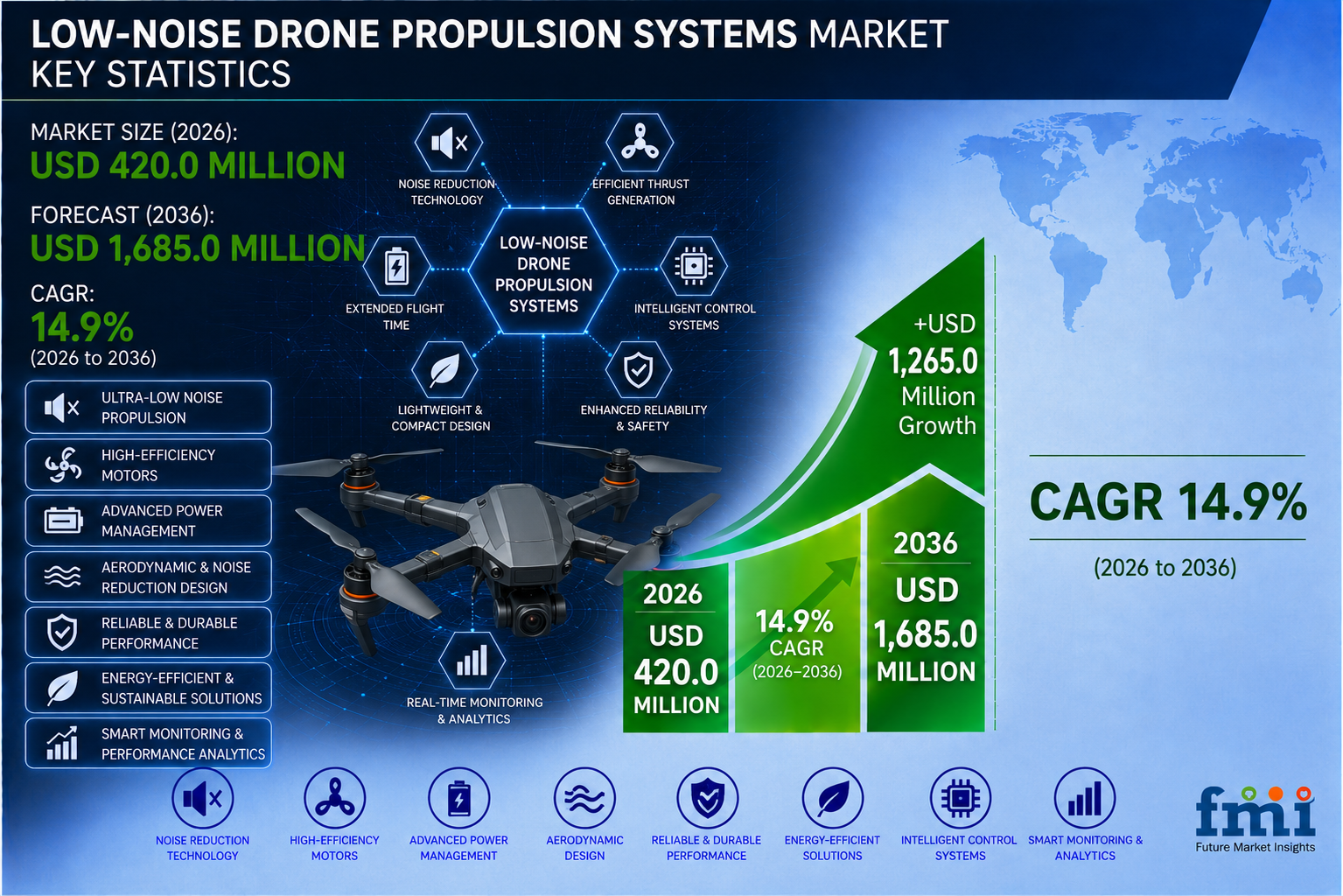
Drone manufacturers and enterprise operators are increasingly focusing on:
Low-noise propeller assemblies
Ducted fan propulsion architectures
Acoustic vibration isolation systems
Intelligent motor control algorithms
Noise-optimized multirotor propulsion systems
Quiet propulsion kits for urban drone delivery
Reduced-frequency blade interaction systems
Integrated propulsion acoustic monitoring platforms
Failure to reduce drone acoustic signatures may expose operators to stricter urban flight restrictions, weaker public acceptance, higher compliance complexity, and reduced scalability for commercial drone deployment programs.
From 2030 to 2036, growth will be supported by increasing urban air mobility activity, expansion of autonomous delivery networks, rising infrastructure inspection programs, and wider regulatory emphasis on drone noise mitigation.
Technology Evolution: Acoustic Optimization and Intelligent Motor Control Drive Innovation
The evolution of low-noise drone propulsion systems is being shaped by advancements in aerodynamic blade design, acoustic simulation software, adaptive motor control systems, and lightweight composite propulsion architectures.
Key innovations include:
Noise-optimized propeller blade geometries
Intelligent motor speed modulation algorithms
Ducted fan drone propulsion systems
Vibration-dampening propulsion mounts
Acoustic signature reduction software
AI-assisted propulsion tuning systems
Lightweight composite low-noise blades
Integrated urban drone acoustic management systems
A major challenge remains balancing propulsion efficiency, payload capability, flight endurance, thermal management, and acoustic reduction performance across diverse drone operating environments.
An industry analyst notes:
"Low-noise drone propulsion systems are evolving from niche engineering enhancements into critical operational technologies for commercial drone scalability. Operators increasingly want propulsion platforms capable of reducing community noise impact while maintaining flight efficiency, payload stability, and regulatory compliance."
Quiet Drone Propulsion Becomes Central to Urban UAV Operations
As commercial drone ecosystems continue expanding into urban, industrial, and infrastructure environments, low-noise propulsion technologies are becoming increasingly important across inspection drones, logistics UAVs, emergency response systems, and autonomous aerial delivery platforms.
Core capabilities include:
Reduced drone acoustic signatures
Improved urban flight acceptance
Enhanced flight stability and vibration control
Better operational compliance with noise regulations
Reduced disturbance during inspection operations
Improved payload efficiency through optimized propulsion
Integrated motor and propeller noise management
Scalable propulsion architectures for autonomous fleets
This transition is positioning low-noise drone propulsion systems as strategic operational infrastructure across logistics networks, industrial inspection programs, smart city deployments, healthcare delivery systems, and advanced autonomous drone ecosystems.
Speak to Analyst: Customize insights for your business strategy:
https://www.futuremarketinsights.com/customization-available/rep-gb-33065
Segment Spotlight
Low-Noise Propeller Assemblies Lead Technology Segment (37.0%)
Driven by increasing enterprise demand for quieter drone flight performance capable of reducing acoustic disturbance without compromising aerodynamic efficiency.
Multirotor Inspection Drones Lead Drone Type Segment (33.0%)
Supported by rising deployment of drones for industrial inspection, infrastructure monitoring, utilities assessment, and public safety operations requiring low acoustic disruption.
OEM-Integrated Propulsion Kits Expand Across Commercial UAV Programs (44.0%)
Reflecting growing demand for integrated propulsion packages optimized for simplified deployment, acoustic balancing, and OEM-certified flight performance.
Regional Insights: Urban Drone Adoption and Regulatory Pressure Fuel Global Growth
The low-noise drone propulsion systems market is expanding globally, supported by rising drone deployment activity, stronger urban airspace regulation, and increasing demand for quieter UAV operations.
Country |
CAGR (2026-2036) |
Key Growth Drivers |
|---|---|---|
South Korea |
15.9% |
Smart city drone programs and urban UAV testing |
China |
15.6% |
Large-scale drone manufacturing and logistics expansion |
Japan |
15.1% |
Urban drone integration and industrial automation |
United States |
14.5% |
Commercial drone deployment and FAA operational expansion |
Germany |
13.8% |
Industrial inspection drones and acoustic compliance |
United Kingdom |
13.4% |
Drone corridor development and urban mobility programs |
Regional growth reflects differences in drone regulation maturity, smart city investment, logistics automation adoption, urban air mobility development, and acoustic compliance priorities.
Opportunities: Urban Drone Ecosystems Unlock Acoustic Innovation
Key opportunities shaping the market include:
Expansion of quiet urban drone delivery systems
Growth in low-noise industrial inspection UAVs
Increasing adoption of ducted fan drone propulsion architectures
Development of AI-assisted acoustic optimization systems
Expansion of integrated propulsion monitoring platforms
Rising investment in drone noise compliance technologies
Growth in smart city aerial mobility programs
These opportunities are enabling suppliers to improve drone deployment scalability, operational acceptance, urban mobility readiness, and long-term UAV ecosystem sustainability.
Competitive Landscape: Acoustic Engineering and Integration Capability Define Leadership
The market remains competitive, with leadership shaped by propulsion engineering expertise, aerodynamic optimization capability, acoustic reduction performance, and OEM integration depth.
Leading companies include:
T-Motor
APC Propellers
Mejzlik Propellers
Master Airscrew
Hobbywing
KDE Direct
Dronamics
Wingcopter
Zipline
Volansi
Competitive differentiation is driven by:
Acoustic optimization capability
Lightweight propulsion engineering expertise
Motor and propeller integration depth
Flight efficiency performance
Urban drone deployment readiness
OEM-certified propulsion architectures
AI-assisted propulsion tuning capability
Multi-mission UAV integration support
Future Outlook: Low-Noise Propulsion Emerges as Foundational Drone Infrastructure
Looking ahead to 2036, low-noise drone propulsion systems will become increasingly important as drone operators continue scaling commercial UAV deployments, autonomous logistics systems, and urban aerial mobility ecosystems.
Key trends include:
Wider deployment of low-noise multirotor propulsion systems
Expansion of urban drone acoustic compliance technologies
Growth in intelligent motor control optimization
Increasing integration of AI-driven propulsion tuning platforms
Higher demand for quiet logistics and inspection drones
Expansion of ducted fan propulsion architectures
Greater investment in acoustic drone certification systems
As drone operations continue evolving toward large-scale commercial deployment, low-noise propulsion systems are expected to emerge as foundational UAV technologies supporting operational scalability, regulatory readiness, acoustic compliance, and sustainable urban drone integration.
Key Developments in the Market
Drone propulsion manufacturers are increasingly expanding development of low-noise propeller systems optimized for urban commercial UAV deployment and infrastructure inspection programs.
Commercial drone OEMs continue integrating intelligent motor control software and vibration-reduction architectures designed to minimize acoustic signatures while maintaining flight efficiency.
Enterprise drone operators are increasing investment in quiet propulsion technologies capable of supporting regulatory compliance, urban deployment scalability, and improved community acceptance across commercial drone operations.
Unlock 360° insights for strategic decision making and investment planning:
https://www.futuremarketinsights.com/checkout/33065
Browse More Industry Reports:
Proptech Market - https://www.futuremarketinsights.com/reports/proptech-market
Trade Management Software Market - https://www.futuremarketinsights.com/reports/trade-management-software-market
Loudspeaker Market - https://www.futuremarketinsights.com/reports/loudspeaker-market
Storage Area Network (SAN) Market - https://www.futuremarketinsights.com/reports/storage-area-network-san-market
RegTech Market - https://www.futuremarketinsights.com/reports/regtech-market
About Future Market Insights (FMI)
Future Market Insights (FMI) is a leading provider of market intelligence and consulting services, serving clients in over 150 countries. Headquartered in Delaware, USA, with a global delivery center in India and offices in the UK and UAE, FMI delivers actionable insights to businesses across industries including automotive, technology, consumer products, manufacturing, energy, and chemicals.
An ESOMAR-certified research organization, FMI provides custom and syndicated market reports and consulting services, supporting both Fortune 1,000 companies and SMEs. Its team of 300+ experienced analysts ensures credible, data-driven insights to help clients navigate global markets and identify growth opportunities.
For Press & Corporate Inquiries
Rahul Singh
AVP - Marketing and Growth Strategy
Future Market Insights, Inc.
+91 8600020075
For Sales - sales@futuremarketinsights.com
For Media - Rahul.singh@futuremarketinsights.com
For Web - https://www.futuremarketinsights.com/
For Web: https://www.factmr.com/
SOURCE: Future Market Insights, Inc.
View the original press release on ACCESS Newswire