FORT WORTH, TX / ACCESS Newswire / November 19, 2026 / Vadzo Imaging, a provider of embedded vision camera products for OEMs and system integrators, today announces validation of 140dB HDR Camera performance on the Innowave-821CRS, built on the Onsemi AR0821 sensor. The camera combines embedded HDR above 140 dB with switchable Ethernet and dual-band Wi-Fi, PoE, ONVIF, PTP, and GPIO triggering. Vadzo presents an AR0821 140dB Ethernet WiFi Camera and an 8MP 140dB Ethernet WiFi Camera for inspection, surveillance, robotics, medical, and document imaging systems.
Why a 140dB HDR Camera Matters in Extreme High Contrast Scenes
Dynamic range is the ratio between the brightest and the darkest signal that a camera can record in one frame. A standard sensor records a modest ratio, so a scene beyond it loses one end, either clipped to white or buried in black. Many scenes fit, and some do not. Direct sun, a welding arc, a stadium light, or a car headlamp can sit in the same frame as a dark doorway or a shaded part, and the detail that software needs- a face, a plate, a weld seam, a printed line- often lives in the dark part.
Engineers usually respond by tuning. They fix the exposure for the region they care about, add light, shade the bright source, or take several exposures and merge them, and each response has a cost in effort, hardware, or motion artifacts. A camera with a very wide range moves some of that work into the sensor, so the same unit serves a bright morning and a dim afternoon without retuning, and a design that must work at many sites needs that margin.
How a 140dB HDR Camera Records Extreme Contrast in One Frame
The Innowave-821CRS is built on the Onsemi AR0821, an 8.3MP (3840 x 2160) color rolling shutter sensor with 2.1 micron pixels. The brief describes embedded HDR above 140 dB through in-pixel processing, which means the merging of brightness information happens inside the sensor, so the data leaves it already combined, and the host does not need to merge frames. A range of 140 dB is a ratio of 10 million to 1, which would need about 23 bits to store linearly, so the sensor compresses its output, and teams should confirm the figure, the method, and the output format against the product documentation.
A short example shows how much range real scenes need. Direct sunlight is about 100,000 lux. A shaded interior might sit at 10 lux, a ratio of 10,000 to 1, or 80 dB, and a dim corner at 0.01 lux makes the full scene 10 million to 1, or 140 dB. Most scenes span far less, so the extra range works as margin, and one camera setting serves many conditions. The figures are illustrative. A lens limits what any sensor can use, because stray light inside the lens, called veiling glare, lifts the dark regions near a bright source and can cap the usable contrast well below the sensor figure. Clean glass, good coatings, and a lens hood protect the benefit.
The camera offers 100Base-T and 1000Base-T Ethernet and dual-band Wi-Fi, so it can sit on a cable or a radio. PoE at 802.3af delivers about 12.95 watts to the device, and Wi-Fi carries no power. ONVIF compliance lets standard software discover the camera, and IEEE 1588 PTP aligns its clock with a network time source, which works best on the wired link. An M12 lens mount accepts many lenses, an electromechanical IR cut filter blocks infrared by day and moves aside at night, and GPIO accepts an external trigger. Teams should confirm the trigger details and the modes against the product documentation, and test the HDR on their own worst-case scene, with the lens that the final system will use.
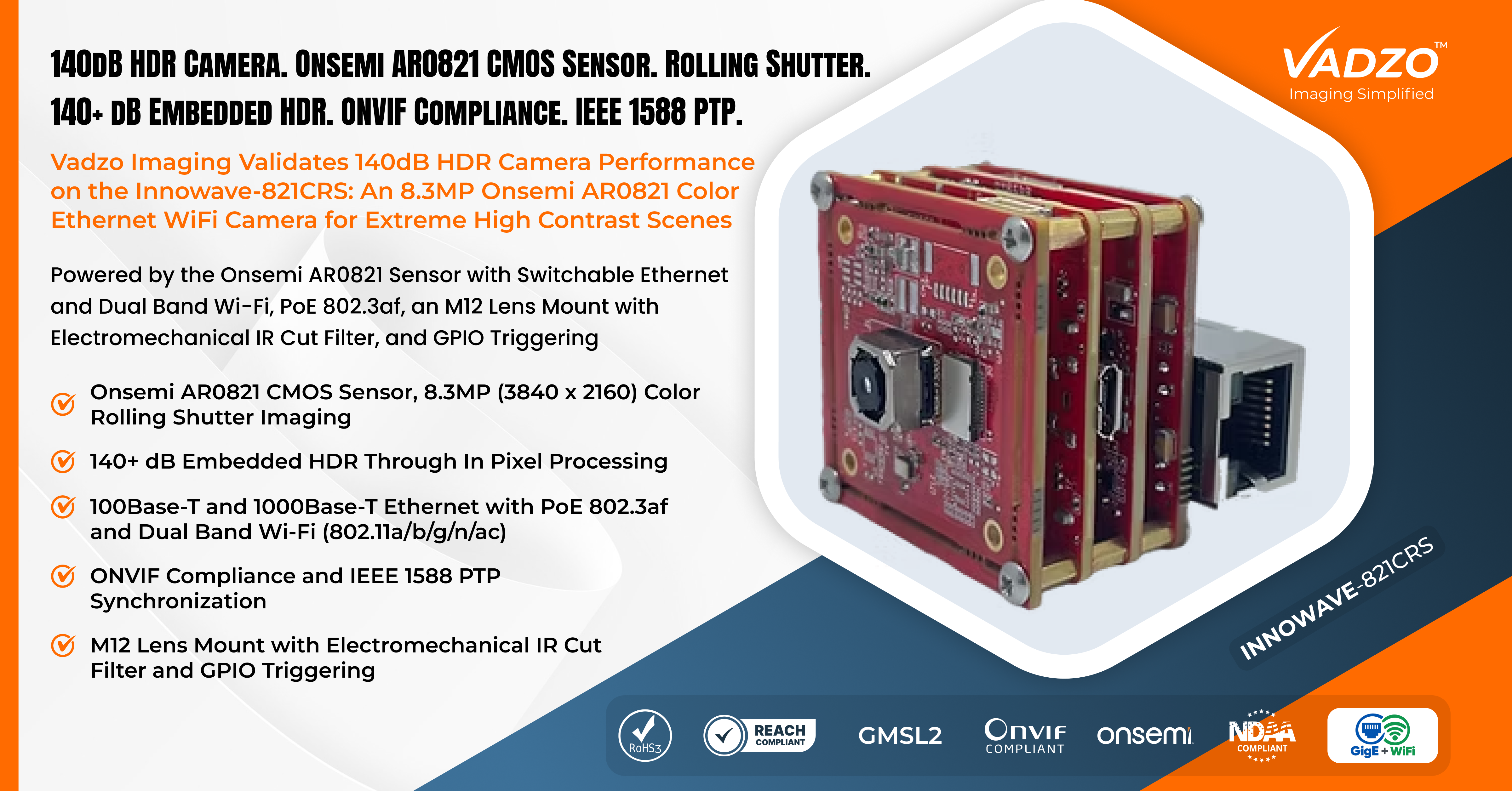
Product Overview: 140dB HDR Camera for Extreme High Contrast Imaging
The Innowave-821CRS is an 8.3MP color network camera built on the Onsemi AR0821 sensor with embedded HDR. As an 8MP HDR Ethernet WiFi Camera, it records bright and dark regions together, and as an 8MP Color Ethernet WiFi Camera, it records full color. The 8MP Rolling Shutter Ethernet WiFi Camera designation covers its readout. The camera also serves as a 4K 140dB Ethernet WiFi Camera, an 8.3MP 140dB Ethernet WiFi Camera, an AR0821 4K Ethernet WiFi Camera, an 8MP 4K Ethernet WiFi Camera, an AR0821 8MP Ethernet WiFi Camera, an 8MP Color HDR Ethernet WiFi Camera, an AR0821 Color HDR Ethernet WiFi Camera, and an AR0821 140dB HDR Ethernet WiFi Camera for designs that need both links.
Key Capabilities of the 140dB HDR Camera
Key specs: 8.3MP (3840 x 2160) Max Resolution | Onsemi AR0821 CMOS Sensor | 2.1 micron Pixel | Color with Rolling Shutter | 100Base-T and 1000Base-T Ethernet with PoE 802.3af and Dual Band Wi-Fi (802.11a/b/g/n/ac) | M12 Optics with Electromechanical IR Cut Filter
140 dB Embedded HDR
The sensor offers embedded HDR above 140 dB through in-pixel processing, a ratio of more than 10 million to 1 between the brightest and darkest signals in one frame. A welding arc beside a dark part, or a window facing the sun, fits in one picture. Teams should test the mode on their own worst-case scene and confirm the figure and the method against the product documentation.
Switchable Ethernet and Dual Band Wi-Fi
The camera offers 100Base-T and 1000Base-T Ethernet and dual-band Wi-Fi with 802.11a, b, g, n, and ac, so a site can run a cable where one exists and a radio where it does not. The 2.4 GHz band reaches farther, and the 5 GHz band is faster and cleaner. Teams should survey the real site before relying on Wi-Fi.
Power over Ethernet
PoE at 802.3af lets one cable carry data and power, about 12.95 watts at the device. Wi-Fi carries no power, so a wireless-only site needs its own supply, and accessories should be checked against the PoE class.
IEEE 1588 PTP Synchronization
PTP aligns the camera clock to a network time source, so recordings from several camera units line up. It performs best on the wired link because wireless delay varies.
ONVIF Compliance
ONVIF compliance lets standard video management software discover the camera and use its video without custom code, which shortens commissioning across many sites. Teams should confirm the profiles and features they need against the product documentation.
M12 Lens Mount with Electromechanical IR Cut Filter
The M12 lens mount accepts a wide range of lenses, and a lens with good coatings protects the usable contrast from glare. The electromechanical IR cut filter blocks infrared during the day for true color and moves aside at night. As an 8MP Ethernet WiFi Camera Manufacturer and an AR0821 Ethernet WiFi Camera Supplier, Vadzo supports lens matching, firmware customization, and enclosure design.
GPIO for External Triggering
GPIO accepts an external signal from a sensor or a controller to start a capture, which suits stations where a part or a person arrives at a known moment. Teams should confirm the number of lines, the electrical levels, and the trigger latency, and test the timing on the real installation.
"Most scenes do not need 140 dB, and that is the point. A camera with that range treats a normal scene as easy, and an extreme one as possible, so the same unit works at a bright site and a dim one without retuning. The Innowave-821CRS offers it with a wired link, a wireless link, PoE, ONVIF, PTP, and GPIO. We are plain about the limits. A lens can cap the usable contrast with glare, Wi-Fi carries no power, and the range figure should be confirmed in the documentation. We help customers test their own worst-case scene." - Alwin Vincent, Product Manager, Vadzo Imaging.
Extreme Contrast Applications for 8.3MP color Ethernet WiFi camera
Automation and Robotics
Industrial quality inspection and robotics meet reflective parts, bright lamps, and welding light. The camera works as an Extreme Contrast Ethernet WiFi Camera on lines and cells, and on mobile carts that move between cabled and wireless zones, with GPIO tying captures to controller signals. Strobe lighting and a short exposure help with fast parts.
Medical Device and Patient Care
Medical imaging and healthcare monitoring meet bright lamps over dim fields. The module serves as a High Contrast Ethernet WiFi Camera in equipment carts, wards, and instruments. Device makers remain responsible for performance claims, patient privacy, and the regulatory pathway of the finished device.
Security and Surveillance
Entrances hold bright streets and dark interiors in one view. The camera functions as a Backlit Scene Ethernet WiFi Camera and a Strong Backlight Ethernet WiFi Camera that keeps faces readable against the sun, and it uses the IR cut filter and infrared illumination at night. Privacy rules apply to recorded video and belong to the operator.
Kiosk and Digital Signage
Document imaging stations capture glossy pages under spotlights. The module works as a Glare Scene Ethernet WiFi Camera on an overhead arm, where wide-range imaging keeps both the bright reflection and the printed line readable, and even lamps still matter as much as the camera.
Frequently Asked Questions
Q: What does 140 dB of dynamic range mean in plain terms?
A: Vadzo Imaging explains that decibels express the ratio between the brightest and darkest signal a camera records in one frame. A range of 140 dB is 10 million to 1, which would need about 23 bits to store linearly. For comparison, direct sun at about 100,000 lux against a dim corner at 0.01 lux is such a ratio. These figures are illustrative, and Vadzo Imaging recommends confirming the range in the product documentation.
Q: Do most scenes need 140 dB?
A: No. Most scenes span far less, and many fit within the range of a standard exposure. The extra range works as margin, so one camera setting serves a bright site and a dim one without retuning, and an extreme scene such as a welding arc or a window facing the sun stays readable. Vadzo Imaging suggests testing an 8MP HDR Ethernet WiFi Camera on the worst-case scene it will meet.
Q: Why can a lens limit usable dynamic range?
A: Light that scatters inside a lens, called veiling glare, lifts the dark regions near a bright source, which reduces the contrast the sensor can use, even when the sensor itself offers a very wide range. Clean glass, good lens coatings, and a hood reduce the effect. Vadzo Imaging recommends testing the lens together with the camera on a scene with a bright source.
Q: How should a team test the HDR performance of a camera?
A: Record the real worst-case scene, such as a bright window with a dark room, at different times of day, with the mode on and off, and compare the detail in the shadows and the highlights. Include a moving subject to check for artifacts. Vadzo Imaging offers evaluation kits for this purpose, and recommends noting the exposure settings with each recording.
Q: Why should integrators choose Vadzo Imaging as their 8MP Ethernet WiFi camera manufacturer?
A: Vadzo Imaging offers more than a camera module built around a capable sensor. Integrators receive a camera with embedded HDR above 140 dB, wired and wireless links, PoE, ONVIF, PTP, and GPIO triggering, with candid guidance on lenses, glare, and the details to confirm in the documentation, plus engineering support for lens selection, firmware customization, and enclosure design. Vadzo Imaging maintains evaluation kits with no minimum order requirement, so teams can test on their own scene before committing to volume production.
Availability
The Innowave-821CRS 140dB HDR Camera, built on the Onsemi AR0821 sensor, is available now for evaluation and production orders. Evaluation kits include the camera, an M12 lens, and platform documentation, with no minimum order requirement. Teams can test the HDR on their own worst-case scene, compare lenses for glare, and confirm both links on their own network before committing to a production bill of materials. Browse the full range of network camera options at Vadzo's website or discuss OEM integration requirements.
About Vadzo Imaging
Vadzo Imaging is a global provider of embedded vision solutions and delivers high-performance camera technologies and imaging platforms for applications in robotics, industrial automation, UAVs, edge AI, and medical systems. Its products are designed for seamless integration with leading embedded platforms. Vadzo supports customers through hardware customization, firmware development, and module-level drivers, enabling faster development and deployment of vision based systems across GigE, USB, MIPI, Wi-Fi, and SerDes camera interfaces.
Media Contact
Alwin Vincent
Vadzo Imaging
Email: alwin@vadzoimaging.com
LinkedIn: Vadzo Imaging
YouTube: Vadzo Imaging
X: Vadzo Imaging
SOURCE: Vadzo Imaging
View the original press release on ACCESS Newswire