TORONTO, ON / ACCESS Newswire / November 13, 2026 / As global financial markets shift toward high-frequency execution and cross-border digital asset settlement, liquidity management platforms face a dual imperative: accelerating transactional throughput while maintaining strict risk controls. Within multi-asset trading environments, operational friction frequently stems not from engine latency, but from the compliance and clearing protocols governing capital flow.
To address the complexities of institutional clearing and regulatory risk, LMSCapitalGroup has detailed its core infrastructure framework, highlighting how service-level agreements (SLAs) combined with automated identity verification protocols manage counterparty risk and protect client capital across volatile trading windows.
The Architecture of Liquidity: Why Settlement Windows Matter
In high-throughput multi-asset trading, liquidity provider (LP) routing requires deterministic settlement schedules. When market participants initiate capital disbursements or reallocate portfolio balances, funds move through a multi-tier clearing stack involving automated fraud detection, banking rails, and compliance screening.
According to technical specifications released regarding LMSCapitalGroup's core ledger, the platform enforces a standardized settlement window of 1 to 3 Business Days for standard fiat and multi-currency transactions.
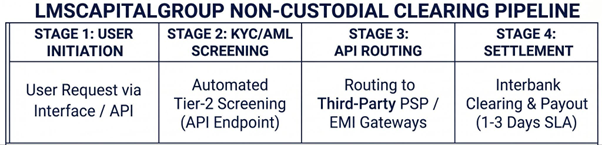
"A defined settlement SLA is not a operational constraint; it is a primary risk management control," notes the platform's infrastructure documentation. "Immediate execution without intermediate verification exposes the liquidity network to settlement fail risk, identity theft, and fraudulent fund routing. Structuring disbursements around a deterministic 24-to-72-hour clearing window ensures that automated risk models can audit transactions against global anti-money laundering (AML) databases without disrupting primary liquidity pools."
Automated Tier-2 KYC Protocols: Mitigating Fraud at the Edge
A central component of LMSCapitalGroup's compliance architecture is its integrated identity proofing and risk-scoring engine. The platform utilizes automated Tier-1 and Tier-2 Know Your Customer (KYC) compliance layers designed to flag anomalous transaction patterns, unverified beneficiary details, and geographical mismatches prior to order execution.
Key elements of the automated compliance protocol include:
- Real-Time Entity Verification: Cross-referencing user credentials and beneficial ownership structures against international sanctions lists, politically exposed persons (PEP) databases, and fraud registries via API-driven verification endpoints.
- Cryptographic Data Protection: Storage and transmission of sensitive verification payloads are secured using AES-256-GCM encryption, preventing interception and ensuring full compliance with international data protection standards.
- Dynamic Risk Screening: High-volume withdrawal requests or modifications to destination account parameters automatically trigger an secondary compliance hold. This operational safeguard requires biometric verification or secondary confirmation, shielding accounts from unauthorized compromise.
Human-in-the-Loop Guardrails in Automated Execution
While LMSCapitalGroup leverages tech-driven investment dashboards and automated algorithmic routing, the platform's execution architecture incorporates Human-in-the-Loop (HITL) guardrails.
In high-volatility events-such as sudden market dislocations or abnormal order flow spikes-automated algorithms can encounter liquidity fragmentation. The HITL framework enforces pre-programmed risk thresholds: if an automated strategy or disbursement request breaches pre-set risk boundaries, the system defaults to manual compliance oversight.
This hybrid control mechanism prevents market manipulation, protects user balances from algorithmic slippage, and ensures that disbursement workflows remain fully compliant with internal audit standards.
System Status and Operational Transparency
To reduce operational ambiguity during the standard 1-3 business day settlement window, LMSCapitalGroup provides transparent transactional status monitoring via its core API endpoints and infrastructure status monitors
By exposing system telemetry-including real-time status updates on AML screening, clearing house operations, and bank transfer processing-the platform enables participants to track fund movements at every stage of the lifecycle.
As institutional participation in digital and multi-asset markets grows, operational transparency, cryptographic data integrity, and strict SLA compliance will remain the benchmark for infrastructure reliability. LMSCapitalGroup's technical framework demonstrates how enterprise security standards and automated compliance protocols operate together to secure multi-asset liquidity in modern electronic trading.
Media & Technical Contact:
Website: https://lmscapitalgroup.net/
Organization: LMSCapitalGroup Infrastructure Team
Email: support@lmscapitalgroup.net
SOURCE: LMSCapitalGroup Infrastructure Team
View the original press release on ACCESS Newswire